Huawei pitches near-packaged optics as co-packaged costs bite
by from www.theregister.com - Articles on (#78CFH)
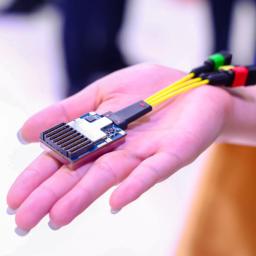 Huawei wants near-packaged optics (NPO) standardized for AI networks, pitching it as a replacement for conventional pluggable modules without the cost and maintenance headaches it attributes to co-packaged optics. The Chinese tech giant showcased an NPO module with a capacity of 7.2 terabits per second (Tbps) at the China International Optoelectronic Exposition (CIOE) held in Shenzhen over September 9-11, and said this will form part of the company's next-gen SuperPOD AI systems. NPO refers to the placement of the optical engine in a network switch as close as possible to the switch's application-specific integrated circuit (ASIC), but still as a separate package plugged into the mainboard. This is one potential option to supersede the pluggable modules now widely used to terminate optical fiber links to a switch. Pluggable modules typically contain a digital signal processor (DSP) to clean up the incoming signal, and their power consumption and heat output increase with network speed. With AI infrastructure pushing network connections to 800 Gbps and even 1.6 Tbps, this is becoming a problem. Another upgrade path for switches is co-packaged optics (CPO), where the optical engine sits even closer - on the same substrate as the switch ASIC silicon. This is expected to deliver low latency and power consumption, but Huawei says the advanced packaging is expensive and makes failed optical engines difficult to replace in the datacenter. This is why Huawei says it is pushing NPO as the pragmatic choice for the near future. "When it comes to optical interconnects, there are two technical choices. One is NPO, near package optics. The other is CPO, co-packaged optics. Compared with CPO, the NPO technology is more mature, making it easier for production ramp up and it's easier for maintenance. So NPO stands as the most mature technology at the moment, and it is also a practical choice in this day and age," said Dr Man Jiangwei, director of Huawei's Advanced Opto-Electronics Laboratory. Huawei says its NPO design eliminates the module's separate DSP by integrating those functions into the ASIC. Man claims this cuts latency from 100 nanoseconds to 10 nanoseconds and reduces power consumption by around 60 percent. "When you put all these factors together, we're able to bring down the cost by a large margin," he claimed. But a project to define NPO standards was officially started only in May this year, at the Q2 meeting of the Optical Internetworking Forum (OIF). Its members include Cisco, HPE, Arista, and Nvidia. The members there were focused on defining a 6.4 Tbps NPO interface with a future extension to 12.8 Tbps, while Huawei is already demonstrating its 7.2 Tbps product. Asked about this at a roundtable to discuss NPO, Dr Man said 6.4T and 7.2T represent the fan-out bandwidth capabilities required by different vendors and system players. "I believe this kind of technical divergence or differing opinions is quite common in standardization. Looking ahead on the standards platform, I'm confident we'll find an appropriate way to ensure compatibility between 6.4T and 7.2T, meeting the needs of the entire industry chain," he said. One of the goals of the OIF NPO project is to come up with common electrical interfaces, mechanical form factors and connectors. Huawei's NPO is understood to employ 200 gigabits per second per lane across a total of 36 lanes, while the proposed 6.4 Tbps OIF interface would use 32 lanes. The company has already committed to using its own NPO in the upcoming third generation of its SuperPOD AI infrastructure platform, an analog of Nvidia's NVL rack-scale systems. The SuperPOD platform links large numbers of Huawei's Ascend neural processing units (NPUs). Huawei declined to say when this SuperPOD will be available, but Dr Man hinted more will be revealed at the Huawei Connect event in Shanghai later this week. He also said Huawei will be "more than happy to share this product with our customers in the downstream, and not only downstream, but we also like to share this technology with the suppliers on the upstream, including various vendors from different countries and regions." Huawei's exposure to US export restrictions, imposed on national security and foreign policy grounds, raises a related question. One roundtable participant asked whether industry adoption could suffer if the Trump administration perceives NPO as Huawei-driven technology. Man said he wasn't the right person to discuss the political environment and reiterated Huawei's commitment to openness and collaboration. "We are happy to work with vendors from different regions, including vendors from the United States, from China, and from Japan. So together we can advance the development of the NPO ecosystem and ultimately contribute to the booming AI ecosystem," he said. NPO isn't the only alternative to CPO. Earlier this year, Arista Networks unveiled its eXtra-dense Pluggable Optics (XPO) concept, which proposes updating pluggable modules to include cooling via an integrated liquid cooling cold plate, and offering up to 12.8 Tbps per module (64 lanes at 200 Gbps each). Huawei pitches NPO as the most mature option; XPO retains the front-panel plug-in module format. Which format will get the widest adoption will depend on switch vendor support as well as customer priorities, and it is likely that NPO, CPO and XPO will coexist for some time. (R)