openEuler brings China's enterprise Linux ambitions to the desktop
Surprisingly few organizations were promoting Linux distros at Open Source Summit Europe. The only dedicated stands we found belonged to two Chinese projects, with openEuler occupying the larger booth.
For users accustomed to Western enterprise distros, openEuler may be a less familiar name, but it has an impressive history. It's the modern free community version of Huawei's EulerOS, a version of which achieved official official UNIXTM certification. openEuler is no longer a solely Huawei project, though. Since then, it's been opened up, and it is now run by the OpenAtom Foundation.
OpenAtom was co-founded in 2020 by Huawei along with some other big Chinese names, such as Alibaba, Baidu, and Tencent. Another of the co-founders was Inspur, which formerly developed its own distro, K/UX - a version of which also achieved official UNIXTM certification.
Inspur K/UX won Unix certification in February 2016, and EulerOS seven months later. K/UX's Unix certification expired in 2019. A few months later, in May 2019, the US placed wider sanctions on Huawei. It is possible that the fresh restrictions on American sales prompted Huawei's interest in closer co-operation with other companies in the Chinese Linux space. As far as we can see, there were no further versions of K/UX after version 3. As additional motivation for cooperation, both EulerOS and K/UX were originally based on CentOS Linux, and of course, in December 2020, the CentOS Project announced it would shift its focus from CentOS Linux to CentOS Stream.
The openEuler community has taken the platform in new directions. It has built its own stack of tools for developing, deploying, and running LLMs, called Intelligence BooM. It has a tool for migrating CentOS Linux systems to openEuler, called x2openEuler. As you would expect, it supports Kubernetes, as well as Docker and Podman, but it also has its own container engine called iSula (named after a species of ant).
Aware that it's less known outside Asia, at the Open Source Summit, OpenAtom was handing out copies of a special "Focus Guide" from Admin Magazine, which is also available as a free download. Some parts of this are also available online without registration, such as AI and the BooM Stack and Automating Migration to openEuler.
openEuler has a dual-strand release cycle, akin to Ubuntu rather than the RHELatives, with LTS versions and more frequent "innovation releases." The current LTS is version 24.03, released in June 2024, while the latest version is 26.09. There is a plethora of versions and editions available on the downloads page: the latest release is for x86-64 and 64-bit Arm. The LTS version adds support for RISC-V and LoongArch, and there are minimal versions for 32-bit Arm as well. The older 22.03 LTS was also available for SW-64, meaning the SunWay RISC processors that Register sister site The Next Platform looked at in 2016. As LWN put it last year, this is a "non-upstream kernel port."
There are five types of installation ISO available: Offline Standard, Offline Everything (a hefty 24.9 GB), Network Install (a still significant 1.5 GB), and two variants of the desktop "DevStation" version - a basic one at 3.3 GB and an "everything" edition at 25 GB.
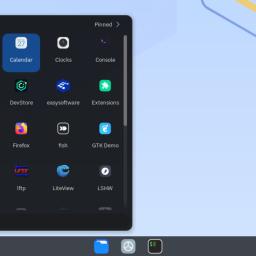
We gave the DevStation a very quick whirl in VirtualBox. It boots into its own installation program called Heolleo, which offers the choice of Simplified Chinese or English. Installation took a while, as it automatically fetches updates as it goes. We ended up with a GNOME desktop configured for Chinese, but we opened Settings, typed "language" into the Search box, and picked English. After a reboot, we could read most of the desktop. Program groups and some other elements are still in Chinese, but it's navigable with a bit of guesswork. It's GNOME 49, with the Dash to Panel and Arc Menu extensions preinstalled for a slightly more familiar layout. Opening a terminal, we were greeted with:
Welcome to 6.18.48-0.0.0.15.oe2609.x86_64
It also offers the Deepin Desktop Environment, UKUI (as seen in Ubuntu Kylin), MATE, Xfce, and the Kiran Desktop Environment, which is a new one to us.
In places, the English-language materials for openEuler mention Chinese CPU makers rather than western ones - which is understandable, in context. Examples include processors from Hygon, a Chinese licensee of AMD designs, as well as Phytium and Kunpeng, which explain the Arm support on offer.
In the western world, the Red Hat user community responded to the end of CentOS Linux by building new free distros that stay as close as they can to their progenitor: the Rocky Linux and AlmaLinux projects, rebuilt from Red Hat source code.
Then, when the IBM subsidiary restricted access to that source to its customers in 2023, the Rocky and AlmaLinux projects started to diverge. Rocky aims for the closest possible RHEL compatibility, and its most visible innovation is that it's built its own new build service. It also found a clever workaround to get Red Hat's kernel source code. AlmaLinux still targets RHEL compatibility, but differentiates itself by retaining older device support and older CPU architectures after Red Hat drops them.
Chinese vendors have responded very differently. Those offering CentOS Linux-based OSes clubbed together, dropped their rival versions and their UNIX compatibility efforts, and instead are working on new tools and subsystems. Much like European interest in digital sovereignty, this is in part due to the Trump administration. Half a decade after it was cut off from its upstream sources, the openEuler platform is thriving and growing, even if few in the western world pay any attention at all. (R)