Quantum leap: IBM plans to scale beyond 1,000 qubits in 2027 with Nighthawk r3 processor
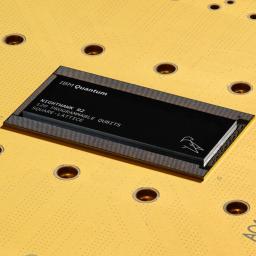
IBM has unveiled the Nighthawk r3, an upcoming next-gen quantum processor that will feature 520 qubits, as another step towards a planned fault-tolerant quantum system it hopes to launch in 2029.
Big Blue's current Nighthawk r2 was only made available in September and features 120 quantum bits (qubits) capable of handling circuits using 7,500 operations.
Its successor, IBM claims, will have more than four times as many qubits and execute 10,000 quantum operations to tackle larger, more complex problems while maintaining the same speed and accuracy.
Nighthawk r3 is slated to arrive in 2027, when Big Blue plans to link two of the quantum processors into a single system with more than 1,000 qubits.
IBM said applications increasingly require circuits executing thousands of quantum operations on approximately 100 qubits or more, speeding up collection of the millions or billions of samples needed to perform complex computations. Speed determines whether such demanding workloads can be completed in practical timeframes and at a reasonable cost.
The new quantum processor will feature 10 chip-to-chip interconnects, called l-couplers, designed for linking together processors that it will use to enable a single 1,040-qubit system. This tech was tested using Nighthawk r1 processors.
IBM previously outlined its goal of reaching reliable error correcting territory in 2029 with a quantum processor codenamed Starling. Now it intends for this to be the world's first fault-tolerant quantum computer, capable of running quantum circuits comprising 100 million quantum operations on 200 logical qubits.
This is an ambitious goal, considering fault-tolerant quantum technology always seems to be at least a decade away, despite numerous breakthroughs and technology introductions. However, some in the technology industry believe the odds on a working system are shortening, given the increased activity around making encryption ready with support for quantum-resistant algorithms.
Then again, a professor at the University of Auckland New Zealand famously claimed last year that quantum computers hadn't so far managed to factor any number greater than 21 without cheating.
IBM presented a framework for Starling in a 2025 paper outlining hardware to implement the improbably named bivariate bicycle quantum low-density parity check (qLDPC) error correction codes. These significantly reduce the number of physical qubits needed to store and process quantum information, compared to existing surface codes.
Using the architecture in the paper, Big Blue intends to assemble Starling from modules that each contain a quantum memory and logical processing unit (LPU), allowing logic operations on the memory. The modules will have universal adapters letting them connect using l-couplers.
IBM is also preparing the way ahead by combining its quantum processors with classical high-performance compute (HPC) systems to research better quantum error correction.
Last week, Oak Ridge National Laboratory (ORNL) in the US announced such a system, combining an IBM Quantum System Two with Nighthawk r2 quantum processors and Umbra, powered by AMD 5th Gen Epyc CPUs and Instinct MI355X GPU accelerators.
IBM also has a partnership with Japan's RIKEN scientific research institute under which an IBM Quantum System Two has been integrated with the Fugaku Arm-based supercomputer, once the most powerful system in the world. (R)