XXRI-OS explores the lowest end of the Linux desktop
New Linux distros seem to appear daily, but far too few distinguish themselves by being smaller and simpler.
XXRI OS is a fairly new desktop Linux distro. It has a snazzy-looking website, complete with an amusing URL, and along similar lines, its GitHub page has a very heavily formatted README. Nonetheless, this is not another over-complex opinionated slopfest of an OS with built-in AI, bizarre keystrokes, and several proprietary components. It's almost the reverse.
The main download is just 287.4 MB, and that's the full distro, not a minimalist installer that fetches most of the OS over your internet connection. We installed it in a VirtualBox VM. It took 675 MB of disk space, and in the graphical desktop, when we opened a terminal window, it reported just 75 MB of RAM in use with the desktop and terminal running. We are restraining ourselves hard when we say that those are unusually low numbers for the 2020s. We would expect most cut-down lightweight Linux distros to use around five to 10 times as much disk space or memory.
The current release of XXRI-OS is version 2.7. XXRI OS 1.0 came out in May 2025, making this a young project with five published releases already behind it. It also has much deeper roots: it is based on the existing and much older Tiny Core Linux. The Reg FOSS desk last looked at Tiny Core Linux 15 back in March 2024 and the project is still going strong: the latest version is version 17.1.
Tiny Core Linux is a marvel, but there are prices to pay for somehow getting a graphical Linux desktop into a 23 MB download. It runs from RAM and uses its own extension-based package system, which can make adding components and managing updates unfamiliar territory. XXRI OS takes TCL and turns it into a slightly more conventional desktop.
It installs to disk in the usual way, and it includes the core functions that most people would expect from their OS in 2026. It has a file manager, a text editor, a media player, a simple app store for adding further components, and a settings app including an update manager. It even includes its own web browser, and there are both x86-32 and x86-64 variants.
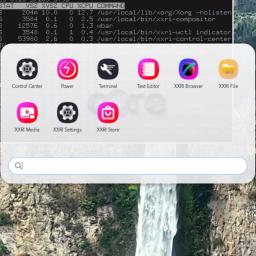
The desktop layout has a floating dock at bottom center, and the icons are unlabelled. To save you some guesswork, though, floating just to the left of the dock is an icon with a grid of dots, which is an app launcher. The icons in that do have text labels underneath, so you can learn which symbol denotes which function from here.
We plan to experiment more with this remarkable little OS and see how well it runs on the oldest, slowest boxes in the Irish Sea wing of Vulture Towers, but we like what we see so far. It's an impressive experiment in how low Linux can go and remain useful. While Tiny Core Linux goes down to Windows 95 levels of resource usage, XXRI OS has a more usable Windows 2000-level baseline. Over a quarter of a century later, that is nearly unbeatable. (R)