Hera probe finds DART left a stadium-sized dent in asteroid Dimorphos
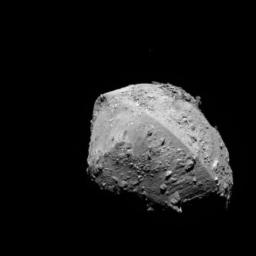
The European Space Agency's Hera probe has revealed a stadium-sized crater on Dimorphos, the asteroid NASA struck with its DART spacecraft in 2022.
The Double Asteroid Redirection Test was deliberately crashed into the asteroid on September 26, 2022. The original plan called for a European spacecraft - Asteroid Impact Mission (AIM) - to launch first and observe the before and after effects of DART. AIM was canceled, and the Hera mission launched in 2024.
DART was a success. Scientists were able to determine that the impact had indeed changed the orbit of Dimorphos. The question was what else had happened to the asteroid. Scientists spotted ejecta and debris following the DART impact, but the close-up observations by Hera have revealed the full extent of the collision.
Hera principal investigator Patrick Michel, Director of Research at CNRS / Observatoire de la Cote d'Azur, said: "Scientists debated whether Dimorphos had sustained an impact crater, changed its shape or stayed the same.
"Much to our surprise the answer turns out to be all three at once! The face struck by DART has been flattened into an impact crater the size of a sports stadium, which extends across the asteroid's entire width."
Scientists also noted that the asteroid is now tumbling in its orbit.
Hera is surveying the 151-meter-wide Dimorphos and its larger companion, the 730-meter-wide Didymos, from about 25 to 30 km away. It moves around the pair at roughly 12 cm/s, using thruster firings to trace rectangular paths rather than conventional circular orbits.
The plan is to approach closer, to about 13 km, to get higher-resolution snaps. A complicating factor is the discovery that hundreds of orbiting boulders surround the asteroids. Michael Kueppers, ESA's Hera mission scientist, said: "The team will have to take account of these objects in the coming weeks as the mission moves in closer."
Hera will deploy two CubeSats, Juventas and Milani, in early 2027. The Italian-led Milani will study surface composition and surrounding dust, while the Luxembourg-led Juventas will use radar to probe Dimorphos's interior before attempting a landing.
Scientists also want to measure Dimorphos's mass. Combined with the observed change in its orbit, that will help them assess how effectively DART transferred momentum to the asteroid and improve predictions for future deflection attempts.
Hera mission manager Ian Carnelli said: "NASA's DART mission demonstrated that we can change an asteroid's orbit. Hera is now revealing what happened to the asteroid itself. By combining these two missions, humanity is taking a decisive step towards making asteroid deflection a reliable tool for protecting our planet." (R)