Sunday Movie: Why Does Nobody Else Build a “Perfect” Metro Like Vancouver? And Where Did the Seattle Monorail Come From?
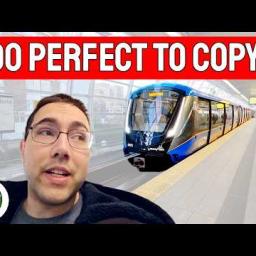
Vancouver built the perfect metro - why won't anybody else? (Classy Whale) Running up to every 2 minutes, mostly elevated, automated. The first half describes the Expo Line and even shorter trains for the Canada Line. The second half explores the question.
A movie about ALWEG, the manufacturer of the Seattle Monorail, and similar lines in Disneyland and Tokyo. (Spur Verloren) The video is in German with no English audio or subtitle options. Martin Pagel provides an English summary:
It shows the remnants of the factory in Fuhlingen near Cologne. No line was ever built in Germany, though Vienna, Cologne and Frankfurt had considered it. Financing came from the Swedish appliance manufacturer Electrolux, run by one of the richest men who had also tried to avert WWII by dealing with Goering. After WWII cars took off, trams got stuck in traffic, subway construction took long and was expensive. Elevated trains would avoid all these problems. He found the solution with two German engineers: a train which runs on a single rail. In 1951 he started a new company, named by their initials: ALWEG. They built a short test line at half scale at 80 km/h. Ultimately they envisioned speeds of 150 km/h in the suburbs, 300 km/h over long distances. The key was that the train would enclose the rail like a saddle does a horse. The technology is sometimes called saddle train or straddle-beam with the advantages of small tower footprint with little shadow and rubber tires generate less noise than steel tires. The technology makes it easier to build guideways along roads, over rivers, and over parking strips without tearing apart cities. Politicians visited the test line. In 1957 a full-scale test line was built. It ran for 10 years and remnants are still visible at the original site though some is covered by a recreational lake now. Once test operation started, one of the leading Disney engineers visited and Walt Disney himself visited the year after. They signed a contract to build one at slightly reduced scale. Once it opened, Richard Nixon visited. It got extended to serve the hotels and therefore became a transit mode, not just a ride. In 1961 a line in Turin was opened for an exhibition. In 1962 ALWEG built the Seattle Center line in only 8 months. ALWEG paid for it in return for ticket income. While the track was built by a Seattle based company, both trains were built in Germany and still operate.
Then Hitachi licensed the technology. The first Japanese line started in 1964 for the Olympics connecting Tokyo with the Haneda airport. Today this line about 10mi long with 11 stations and an average daily ridership of over 100,000.
In Germany transit planners had considered a line in Cologne, five in Frankfurt and one in Vienna. Most cities decided to build a subway instead, mostly out of aesthetics, the larger size and operating time (10-20sec) of the switches, tire wear, and higher power consumption. Evacuation can also be tricky. But the biggest challenge has been the lack of interoperability with existing rail lines and stations. In 1963 ALWEG proposed a whole network of lines for Los Angeles. ALWEG's backer had died and Krupp Steel took over the company and the cities which had considered a monorail built subways instead.
Jena, in East Germany, had also considered a line, but East Germany decided to use their own trams rather than buying from West Germany.
Hitachi built more lines in Japan. Other German companies built a few lines. If you still want to see ALWEG's technology, go to Seattle or Tokyo. Turin still has a station. The 7th generation runs at Disney.
ALWEG did not come up with the monorail system but the saddle technology. The first monorail system was built in Wuppertal where the trains hang off a single track.
The technology is still being built and deployed by Hitachi and Bombardier.
Musical interlude: Crazy Downtown (Alan Sherman parody), Downtown (Petula Clark original).
This is an open thread.