Gravitational waves: Going beyond LIGO
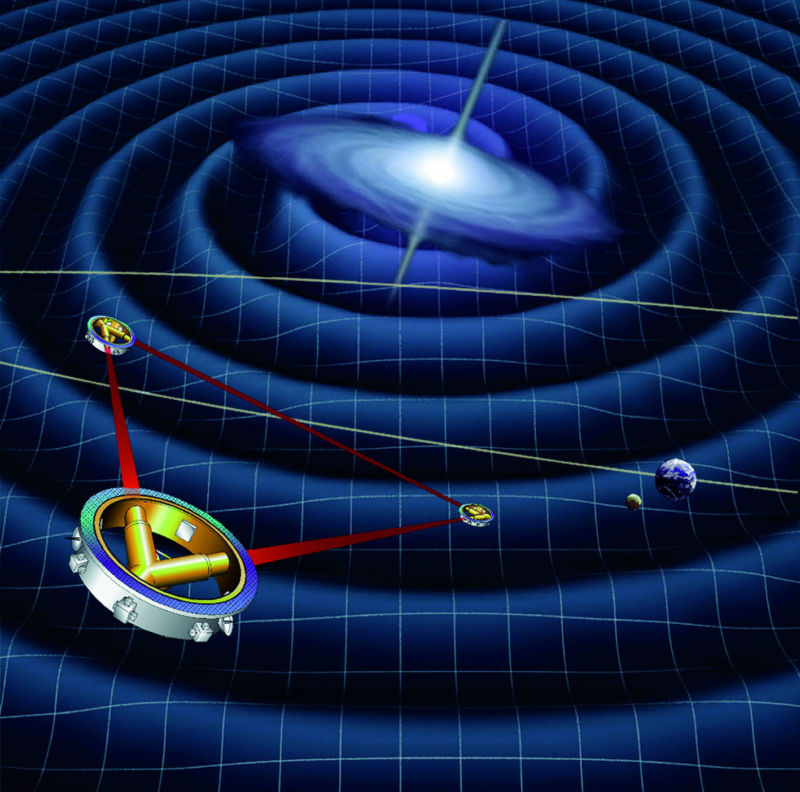
Enlarge / The LISA mission, currently in planning, will create a space-based gravitational wave detector. (credit: ESA)

Up until a year ago, gravitational waves were a theoretical construct, a consequence of the theory of relativity. We had indirect evidence that they were real, as energy was lost from binary star systems just as Einstein predicted. But directly observing them took the upgraded Laser Interferometer Gravitational-Wave Observatory (LIGO). As soon as we detected them, however, astrophysicists were quick to point out that they gave us a completely new window through which we could view the most energetic events in the Universe.
As a sign of just how seriously that claim is being taken, European physicists just opened up a new detector. Called VIRGO, it will combine with LIGO to give us a better picture of where events are taking place. And Virgo isn't the end. Researchers used the meeting of the American Association for the Advancement of Science to discuss the next generations of gravitational wave detectors-as well as the continuation of what's now a decades-long experiment that has come up empty so far.
VIRGO and LIGO work based on the same physical principles. Laser light is sent back and forth between mirrors at the ends of two perpendicular 4km long arms. After a sufficient number of trips, they're recombined in a way that lets small changes in the distance between the mirrors to be detected. Passing gravitational waves ripple the fabric of space, changing that distance infinitesimally.
Read 16 remaining paragraphs | Comments