White dwarf flies around a black hole every 28 minutes
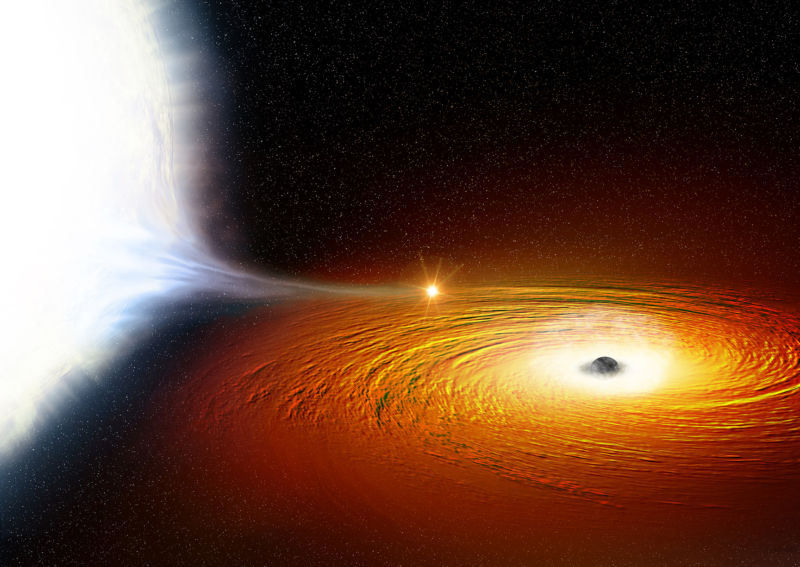
Enlarge / Artist's conception of the black hole in 47 Tucanae X9 siphoning matter off the white dwarf. (credit: NASA/CXC/M.Weiss)
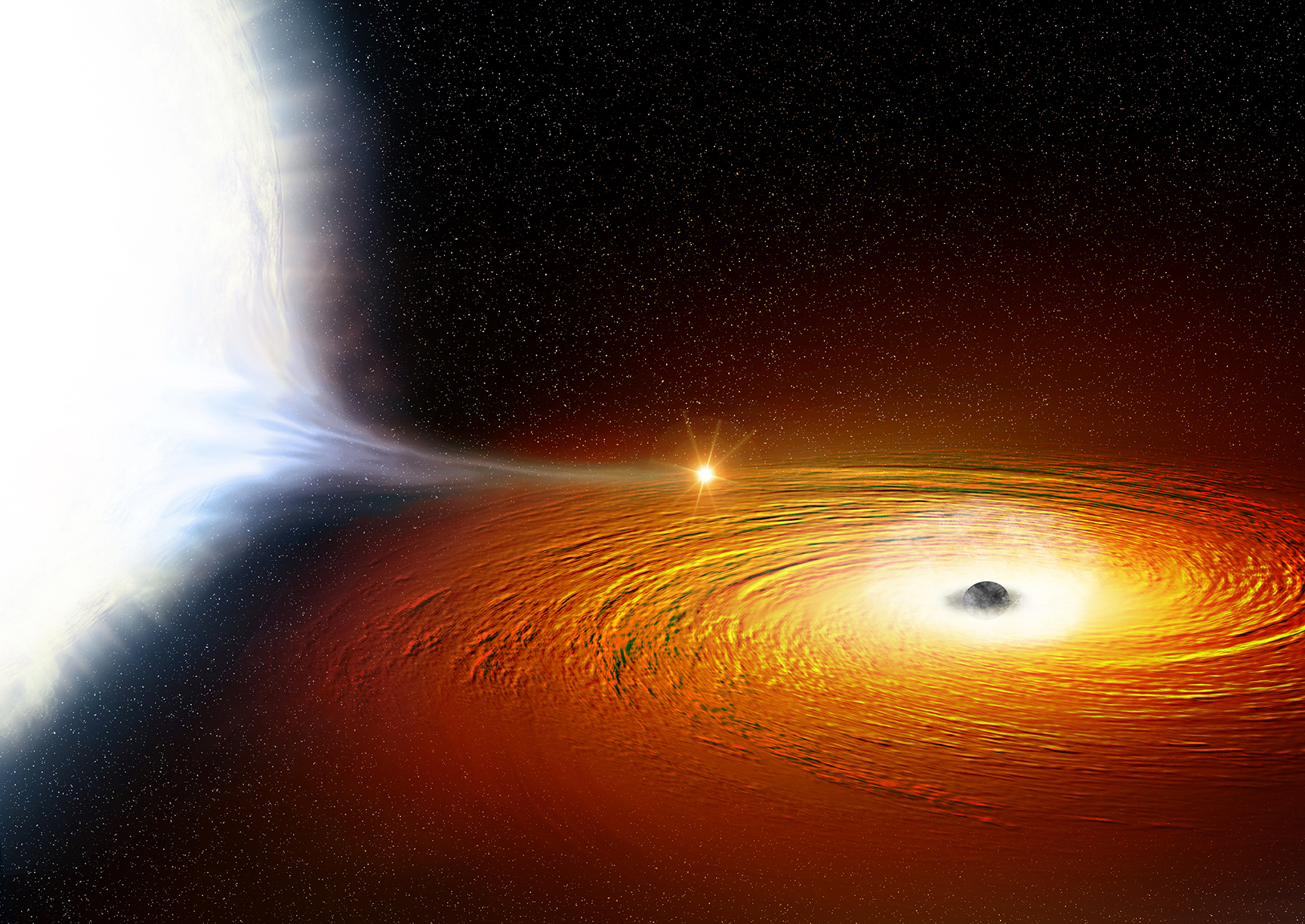
In a study based on new observations from the Chandra X-ray Observatory, NuSTAR and Australia Telescope Compact Array, a team of researchers may have confirmed the presence of a black hole and a white dwarf star in the tightest orbit ever seen.
The system was observed in the 47 Tucanae globular cluster, is located about 16,700 light-years away in our own galaxy, and is the second-brightest globular cluster in the night sky. It's also the site of the recent discovery of the first intermediate-mass black hole yet found. It's a fertile ground for studying the role of black holes in globular clusters.
The system in question, 47 Tuc X9, is the brightest X-ray source in 47 Tuc's core. Researchers initially thought its most massive constituent might be a so-called cataclysmic variable, a system whose brightness regularly increases and decreases. This occurs in a binary pair of stars in which material from the donor star (typically a white dwarf) falls onto the more massive (roughly Sun-mass) star, leading to the increased emissions.
Read 13 remaining paragraphs | Comments