Vanishing star hints at direct collapse to black hole
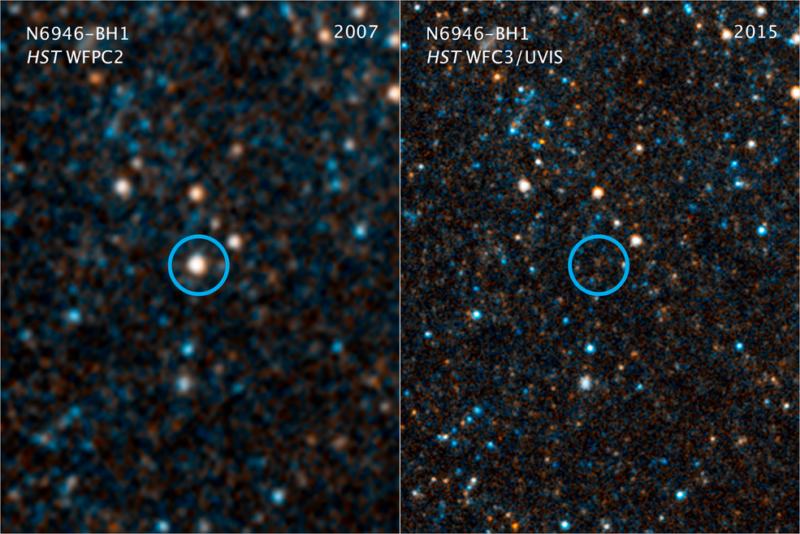
Enlarge / First you see it, then you don't. (credit: NASA, ESA, and C. Kochanek)
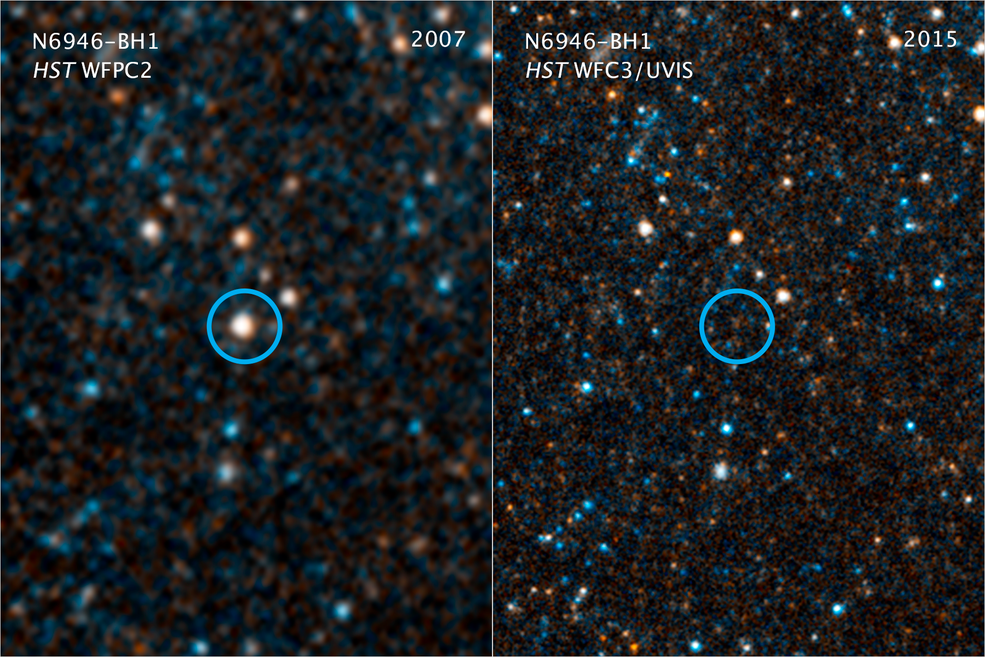
The rules for a stellar death seem pretty simple. If the star isn't that massive, it burns out into a carbon-rich remnant called a white dwarf. If it's big enough, the star ends in a bang, exploding in a supernova that can leave behind a neutron star or a black hole. But a number of simulations have suggested that there's another option: big stars that go out not with a bang but a whimper.
The idea is that, rather than exploding, much of the mass of the star falls inward to the core, forming a larger black hole. While some of the outer layers of the star are shed and it brightens briefly, there's no catastrophic explosion. Now, researchers about to publish in Monthly Notices of the Royal Astronomical Society have identified one of these collapses in the form of a star that seems to have vanished.
No bangWhile supernovae are often called explosions, they're actually a bit more complicated than that. Deep within the soon-to-be supernova, all the lighter elements have been fused, leaving the core to undergo reactions that absorb energy. Without any excess energy to push back against gravity, the interior of the star collapses, forming a black hole or neutron star. It's only the outer layers that are jettisoned, creating an outburst of light and material.
Read 8 remaining paragraphs | Comments