New study suggests Jupiter’s formation divided Solar System in two
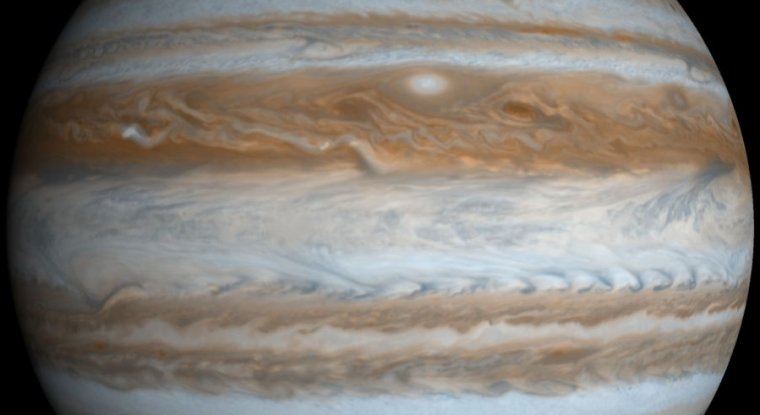

Gas giants like Jupiter have to grow fast. Newborn stars are embedded in a disk of gas and dust that goes on to form planets. But the ignition of the star releases energy that drives away much of the gas within a relatively short time. Thus, producing something like Jupiter involved a race to gather material before it was pushed out of the Solar System entirely.
Simulations have suggested that Jupiter could have won this race by quickly building a massive, solid core that was able to start drawing in nearby gas. But, since we can't look at the interior or Jupiter to see whether it's solid, finding evidence to support these simulations has been difficult. Now, a team at the University of Mi1/4nster has discovered some relevant evidence in an unexpected location: the isotope ratios found in various meteorites. These suggest that the early Solar System was quickly divided in two, with the rapidly forming Jupiter creating the dividing line.
Divide and conquerBased on details of their composition, we already knew that meteorites formed from more than one pool of material in the early Solar System. The new work extends that by looking at specific elements: tungsten and molybdenum. Molybdenum isotopes serve as a marker of the source material for our Solar System, determining what type of star contributed that material. Tungsten acts as a timer for events early in the Solar System's history, as it's produced by a radioactive decay with a half life of just under nine million years.
Read 10 remaining paragraphs | Comments