DNA from old skeleton suggests humanity’s been here longer than we thought
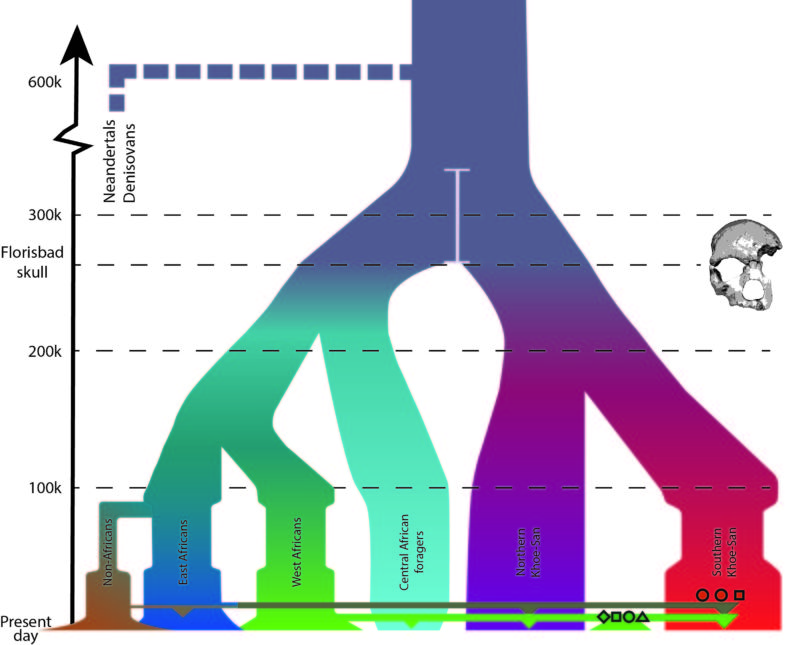
Enlarge / Our family tree, with the dates inferred from this new data. Note how many major branches there are within Africa, and the recent exchange of DNA at the bottom. (credit: Schlebusch et al., Science)
When did humanity start? It's proven to be a difficult question to answer. Anatomically modern humans have a distinct set of features that are easy to identify on a complete skeleton. But most old skeletons are partial, making identification a challenge. Plus, other skeletons were being left by pre-modern (or archaic) human relatives like Neanderthals who were present in Africa and Eurasia at the same time. While Neanderthals et al. have distinct features as well, we don't always have a good idea how variable those features were in these populations.
So, when a recent paper argued that a semi-modern skull meant that humanity was older than we thought, some people dismissed it as an overhyped finding.
On Thursday, a new paper was released that makes the case that humanity's older than we thought. The finding is based on a different type of evidence: a genome from a stone-age skeleton in southern Africa. There's enough uncertainty in the work that this won't settle the issue, but the paper reinforces earlier findings that the secret to understanding our past will be found in Africa.
Read 12 remaining paragraphs | Comments