NASA to pull an IKEA by dropping tons of plastic, metal, and glass on the Moon
by from www.theregister.com - Articles on (#75WZ0)
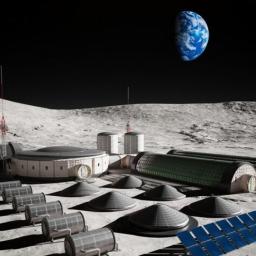 Within three years, NASA hopes to resume crewed Moon landings, but unlike their snapshot-happy, golfing Apollo predecessors, future Artemis astronauts may spend part of their time assembling the foundations of a permanent lunar outpost, the agency said on Tuesday. Between now and 2029, NASA says its Moon Base initiative could involve up to 25 missions, including 21 lunar landings, delivering about four metric tons of cargo to the surface along with the first transportation systems for astronauts. NASA on Tuesday announced contracts with four companies to build and deliver hardware for the agency's planned Moon Base program, the first major procurement update since it outlined the strategy earlier this year. The awards went to Blue Origin, Astrolab, Lunar Outpost, and Firefly Aerospace . The contracts cover cargo lander missions, two lunar terrain vehicles, and a carrier spacecraft for a set of robotic MoonFall drones under development at NASA's Jet Propulsion Laboratory. NASA Administrator Jared Isaacman said this is part of a broader push to establish a permanent American presence on the lunar surface, as well as a lunar economy" that sees future missions, science, and outposts financed by corporations rather than public funds. We can't force a lunar economy into existence. I suspect in the years, decades ahead as we build and operate what's hopefully multiple lunar outposts that we will uncover something along the way," Isaacman said. This is a step in the right direction." Blue Origin received a $188 million task order, plus a $280.4 million option period, to deliver NASA's lunar terrain vehicles to the South Pole region using its Mark 1 uncrewed lander. The same lander variant will fly the first mission in the series, designated Moon Base I, which NASA says will carry science payloads to the Shackleton Connecting Ridge no earlier than fall 2026. Astrolab and Lunar Outpost won contracts worth $219 million and $220 million respectively to build crewed and autonomous lunar terrain vehicles capable of carrying two astronauts across the lunar surface. NASA said the rovers are expected to travel more than 9 mph (14.5 km/h) and cover more than 124 miles (200 kilometers) over their operational lifetimes. Astrolab will deliver a vehicle called CLV-1, adapted from its existing FLEX rover architecture, while Lunar Outpost will provide Pegasus, derived from its Eagle terrain vehicle. Lunar Outpost's subcontractors include General Motors, Leidos, and Goodyear. NASA's three-phase Moon Base plan calls for up to 25 missions, including 21 landings, during Phase 1, which runs through 2029 and aims to deliver about four metric tons of cargo to the lunar surface. Phase 2, covering 2029 through 2032, would scale deliveries to as much as 60 metric tons of cargo and introduce semi-permanent infrastructure including power systems, communications networks, and habitation modules. Phase 3, beginning in 2032, targets sustained human habitation supported by advanced rovers, surface nuclear power systems, and delivery capacity of up to 38 metric tons of cargo per year. Firefly Aerospace won the contract to build the carrier spacecraft that will transport JPL's "MoonFall" drones from Earth to lunar orbit before releasing them for independent landings approximately a mile apart. The value of that contract was not disclosed. Carlos Garcia-Galan, the Moon Base program manager, said the drones will map the lunar surface at centimeter-scale resolution, as well as hunt for subsurface water ice, and record the radiation environment ahead of future crewed missions. "Not only can they accomplish the mission, they can hop, go to multiple locations, but they can also survive the long lunar nights," Garcia-Galan said. "When they get sun again, they can serve a permanent objective wherever they ended up at." Garcia-Galan acknowledged the difficulty ahead. "It dawns on us every day how little we know of the lunar surface," he said, noting that the Apollo program and subsequent robotic missions explored only a fraction of the Moon. Dr. Lori Glaze, the head of the Artemis program, pointed to the April flight of Artemis II as a test of the systems that will underpin future missions. She said NASA is already moving hardware for Artemis IV and V into integration at Kennedy Space Center and continuing work with both Blue Origin and SpaceX on Human Landing System vehicles intended for future Artemis missions, including Artemis III, which NASA targets for a mid-2027 launch. "Artemis II proved that NASA is ready for the next step," Glaze said. "And that next step is coming fast." When asked about timelines for permanent habitation, Garcia-Galan said Phase 2 would introduce a pressurized rover that allows astronauts to live and work on the surface for short stays beyond what a lander alone can support. He stopped short of giving a date for full-time occupation, saying that permanent habitation depends not just on a single asset but on an entire logistics chain that does not yet exist. On funding, Isaacman mentioned three sources: more than $10 billion from the reconciliation legislation passed last year, fiscal year 2026 appropriations, and the fiscal year 2027 presidential budget request. He said the combined funding is "more than adequate to meet our exploration goals." NASA said additional lander mission awards under its CLPS program and selections for its next-generation CLPS 2.0 cargo lander contracts will follow in the coming months. The agency also said it is negotiating contribution agreements with international partners, though officials offered no specifics. (R)