Japan’s asteroid sample retriever rapidly buzzes remote space rock
by from www.theregister.com - Articles on (#76SHT)
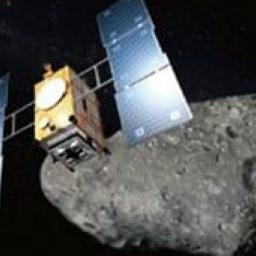 Japan's Hayabusa2 craft has just buzzed an asteroid, successfully completing the first objective of its extended mission. Hayabusa2 launched in 2014, and four years later arrived at Asteroid Ryugu. In 2019 the craft sent a pair of landers onto Ryugu's surface and collected samples that it dropped off in the Australian outback in late 2020. Analysis of those samples suggests Ryugu is home to amino acids, and probably came from the outer solar system before somehow settling into an elliptical orbit that crosses over the celestial paths traversed by both Earth and Mars. After delivering its sample, the craft then headed back into deep space - with around 30 kilograms of propellant aboard. Japan's Space Exploration Agency (JAXA) soon defined an extended mission with two objectives. The last of those will hopefully occur in 2031 at Asteroid 1998 KY26, a tiny space rock that astroboffins think may be just 11 meters wide. JAXA ticked off the other objective on Sunday with a flyby of asteroid 98943 Torifune, a 450-meter diameter rock. The space agency decided to visit Torifune out of scientific curiosity, and because it's conveniently located for Hayabusa2. The fact that the asteroid's orbit intersects Earth's was another motive, as JAXA feels anything we can learn about the object can contribute to planetary defense strategies. Expectations for the flyby were low, because Hayabusa is set up to observe asteroids at close quarters - but it sped past Torifune at around five kilometers per second. JAXA managed to maneuver the craft to within 800 meters of the asteroid and has said Hayabusa2 operated normally after the flying visit. The agency hasn't released detailed data or images. We'll update this story if it does so after a planned press conference later today - but for now hope readers appreciate the many excellent feats of engineering and astrogation that made the flyby possible. Hayabusa2 was JAXA's second sample return mission and the agency hopes to soon launch another in the form of the Martian Moons eXploration (MMX) spacecraft, which it hopes to launch in November or December. The mission plan calls for the craft to land on Phobos next year and grab some samples that will land on Earth in 2031. If successful, the mission will be the first to land on Phobos. JAXA's also working on another interesting project: a voice interface for spacecraft. As explained in an announcement posted last Friday, the Mission Buddy" project aims to replace complicated instrument panels with a conversational interface. Mission Buddy' is not simply a mechanism for personifying spacecraft, but is positioned as a cognitive interface that connects researchers, operators, educational institutions, and general users through dialogue, based on mission information, observation data, operational knowledge, and research results," JAXA wrote. This is expected to create a wide range of value, including mission understanding, learning support, science communication, knowledge transfer and utilization, and even multilingual information dissemination." (R)