Satya sorry for SaaS-y SNAFU - look over there, more AI!
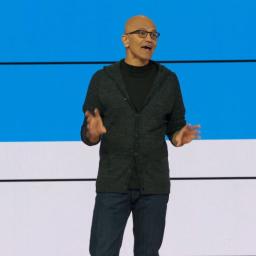
Microsoft CEO Satya Nadella's Ignite conference keynote on Tuesday was all about trust. He opened by promising to earn back trust after last week's massive M365 outage and went on to focus on the need for organizations to trust their AI models.
"So last week in some sense was really a reminder of how critical digital infrastructure is as the dial tone for the world," said Nadella. "We know the trust you place in our services and take that responsibility extremely seriously. And in that context, I know we have work to do to provide that resilience that you can count on, the world can count on, and we are committed to ensuring that we learn and we continuously improve."
Speaking at San Francisco's Moscone Center, Nadella described three areas of focus for the company as it works to build what he referred to as a frontier ecosystem: "Keeping the human at the center of it all, ensuring that you have ownership over your organization's intelligence and learning, and trust."
Anthrocentrism is a tough sell just weeks after offering buyouts to 60,000 employees. Describing the shift from hand-written code to agent-written code, Nadella suggested developers have moved from building software artifacts to building software factories that build those artifacts.
"The important thing here though is to remember still that that human intent, that judgment, that experience, skills, expertise all very much matter," he said.
People may judge development work, but ask them whether they have the same sense of ownership as when they wrote every line.
As to ensuring that organizations have ownership over their intelligence, that borders on heresy for a company with massive cloud computing commitments specifically to run AI workloads. If everyone really owned their machine learning models and ran them in their own data centers and on employee computers, Azure would be in trouble.
Yet Nadella emphasized ownership - which isn't at all obvious given the legal ambiguity of who owns AI generated code and whether it can be copyrighted.
"In the age of AI, the key question is how do individual firms continually build and own their learning and tacit knowledge?" he said. "For an economy to remain an economy where many firms exist and thrive, intelligence by definition needs to be broadly distributed versus just collapsed into a couple of models."
Suffice to say that Nadella is promoting client control over AI data that's processed mostly on equipment rented from Microsoft, with some allowance for customer-controlled infrastructure. But that still ought to concern frontier AI labs like Anthropic and OpenAI that favor a white-glove, black-box service model where they are the arbiters of access.
As for the third pillar of Nadella's vision, that's trust, which remains missing in action.
"How can you even trust all this powerful technology?" Nadella asked. "And the reality is, by definition, you can't. In other words, it becomes an architectural imperative to separate the supply of intelligence from the authority over it. And so our goal is to build a stack that addresses these three architectural imperatives."
Microsoft's original stack was built on ownership of the operating system. But the company's commitment to AI is such that it now describes Copilot in the terms once reserved for Windows.
"Copilot is the new operating system for work," said Nadella.
AI is eating software, and Microsoft is here for itFifteen years ago, venture capitalist Marc Andreessen famously observed that software is eating the world. Now AI, including Copilot, is eating software.
"Apps are just plugins to Copilot," Nadella mused. "That's why we in fact have brought all of Office, all of its richness, right built into Copilot."
Copilot is eating other companies too. Nadella said Microsoft is extending Copilot to take on specific roles by providing skills, connectors, and plugins for industry-specific tasks. Toward that end, "Copilot is the new front door to Dynamics 365," which now offers CRM plugins. And Nadella announced a partnership with Salesforce called Copilotforce that brings Salesforce context into Copilot, Teams, and Fabric.
He also talked up Microsoft IQ, the company's new enterprise context management platform.
"The idea behind IQ is to help every organization build, retain, and continuously improve your own intelligence across the organization," said Nadella, describing it as an externalization of the context system underlying Copilot.
Nadella went on to announce a new model family for GitHub Copilot Fusion, its code hosting subsidiary's model orchestration and routing play. He noted that Copilot Fusion today is ranked above Anthropic's Claude Opus 5.5 at less than half the cost on Terminal Bench, a measurement of how well AI agents complete tasks using a terminal.
Then there's Copilot Workspaces, which Nadella described as a multiplayer version of Copilot. Instead of a chat window where one person interacts with a model, it's an interface for team collaboration that shares context with a model.
Microsoft's decision model, intended to challenge TypeSafe AI's Jev, debuted about a month ago and now Decisions 1.1 is generally available.
"We have improved performance, making decisions more accurate and responses faster," said Nadella. "Already over 4,000 customers have used it."
He then said that Microsoft Foundry would offer OpenAI's GPT-6.2, which may have caused some confusion because at that point, OpenAI had no such model. A short time later, OpenAI announced GPT-6.2 Astra and Sol.
Microsoft also rolled out new coding models, in the form of Code 2, Code 2 Flash, and Cyber 2 Flash, and said its next-gen Cobalt 200 VMs are generally available.
It's a question of trustAfter rattling off the various products and services Microsoft has prepared to help organizations with intelligence ownership, Nadella returned to the question of trust.
"Today we can see almost everything that models touch, but you cannot see what happens inside a model," he said. "And really what's worse is that we know that what a model tells us about itself is not even independent evidence and therefore cannot be trusted.
"And one model monitoring another model has the same issue. So you essentially have these unacceptable nested sets of black boxes, which we now need to make transparent and verifiable."
Microsoft's bid to bridge the trust gap is the Microsoft Transparency Initiative. The company says this will involve engagement with the National Institute of Standards and Technology's "SI Agent Standards Initiative."
Whether Microsoft AI will be compatible with NIST SI remains to be seen. That initiative also calls for collaboration with other organizations to develop accountable, verifiable, vendor-neutral AI transparency standards, and for Microsoft to incorporate this work into Microsoft AI, Foundry, and Copilot. Check in next year to see whether transparency is achieved. (R)