 |
by Guardian Staff on (#EWEG)
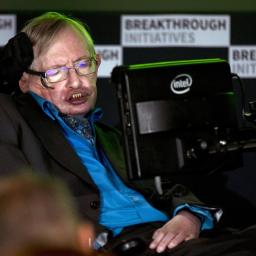
Stephen Hawking on Monday helps launch an intensive search for alien life. The project, Breakthrough Listen, backed by Russian billionaire Yuri Milner, will allow telescopes to eavesdrop on planets that orbit the million stars closest to Earth and 100 nearest galaxies. 'Somewhere in the cosmos, perhaps, intelligent life may be watching these lights of ours,' says Hawking, speaking at the London launch Continue reading...
|
| Link | http://feeds.theguardian.com/ |
| Feed | http://feeds.theguardian.com/theguardian/science/rss |
| Updated | 2026-10-01 03:45 |
 |
by Reuters in Berlin on (#EW7R)
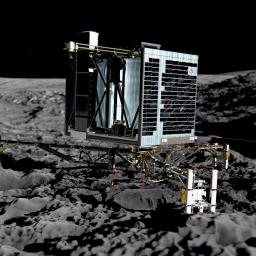
Lander which became first to touch down on a comet is not responding to commands, raising fears it may have moved againThe Philae comet lander has fallen silent, European scientists have said, raising fears it has moved again on its new home millions of miles from Earth.The fridge-sized robotic lab, which landed on comet 67P/Churyumov-Gerasimenko in November, last made contact on 9 July and efforts to reach it again have so far failed, experts working for the historic European Space Agency project said on Monday. Continue reading...
|
 |
by Martin Rees on (#EW3A)
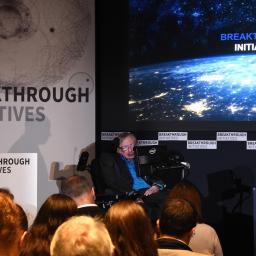
As the Breakthrough Initiative starts scanning far galaxies for radio waves, it is important to remember intelligent life may take a very different form from us
|
 |
by Alex Bellos on (#EVTX)
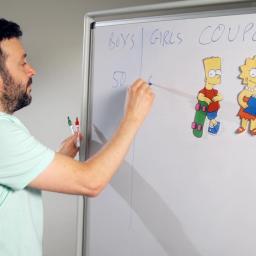
What family planning solutions did you come up with to maximise the proportion of girls in the population?Hello again. This morning I set you this problem:
|
|
by Alex Bellos, Tash Reith-Banks, Ian Anderson and Pa on (#EVV0)
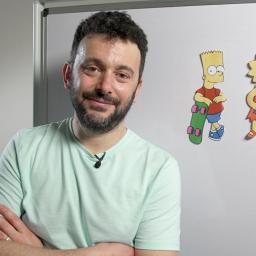
This puzzle was all about working out the proportion of girls to boys if a fictional government created a policy to change the ratio of the population. Did you solve it? Did you work out a humane answer?
|
 |
by Alex Bellos, Tash Reith-Banks, Ian Anderson and Pa on (#EV68)
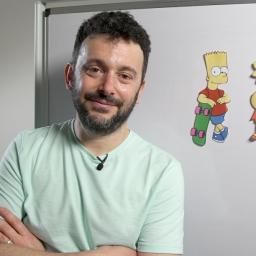
Alex Bellos ponders how a fictional government planning to increase the proportion of girls to boys would implement a family planning policy – and what would happen if it did. Can you work out how this could be done mathematically ... and humanely? Test your brain power with imaginary Bart and Lisa Simpsons
|
 |
by Alex Bellos on (#EV6A)
It’s a family planning puzzle – can you maximise the proportion of girls in the population?This week I’ve got babies on my mind because I’m about to become a dad. And thinking about kids has led me to my favourite conundrum about family-planning:The government – which wants to increase the ratio of girls to boys – introduces a law for all couples that states: Continue reading...
|
by Karen Andrews on (#ETZ5)
The Square Kilometre Array, the world’s largest telescope, connects Australian research, science and industry – crucial for forging a path to economic prosperityLast week I visited the Murchison Radio-astronomy observatory in regional Western Australia, the future Australian home of the world’s largest telescope, the Square Kilometre Array or SKA. As a mechanical engineer I was in awe of the scale and vision of the project.It’s a great example of “moon shot thinkingâ€. In 1961 the US president John Kennedy said he was going to put a man on the moon, but he had no idea how to do it. With the SKA we’re building the world’s largest telescope with no real idea of what we’ll find. The SKA will comprise thousands of antennas that capture radio waves emitted from stars, galaxies, supernovae and black holes. Some of the radio waves will come from objects that are so far away they have since disintegrated. It will effectively provide us with a 3D Google map of the universe. Continue reading...
 |
by Reuters in Washington on (#ET35)
Lockheed to purchase Sikorsky Aircraft, US military’s largest helicopter supplier, in its biggest buy in two decades – which government will examine closelyLockheed Martin, the largest US weapons maker, has agreed to buy United Technologies’ Sikorsky Aircraft unit, the maker of Black Hawk helicopters, for more than $8bn, a source familiar with the negotiations said on Sunday.The two companies plan to announce the deal on Monday before both report second-quarter results on Tuesday, said the source, who was not authorised to speak publicly. Continue reading...
|
 |
by Kareem Shaheen in Dubai on (#ESNV)
UAE-designed and built craft will set off in 2020 as part of a project aimed at inspiring a new generation within the regionWhen asked if he was nervous, 32-year-old Omran Sharaf was unequivocal. “Of course,†he says. “The reputation of the nation depends on this.â€If all goes well, the United Arab Emirates will have a space probe orbiting Mars by 2021 – a first for an Arab world embroiled in endemic conflict. And, as the man leading the Emirates Mars Mission, Sharaf has a lot on his plate. “It’s the first time we go to Mars,†he says. “I have to say, I think the team doesn’t sleep. But it’s something we have to do if we want to progress and move forward. If we can reach Mars, all challenges for the nation should be doable.†Continue reading...
|
 |
by Dara Mohammadi on (#ERPQ)
Low profit margins and the difficulty of finding new drugs has led to big pharma shutting down its antibiotics programmes. But now researchers are adopting new approaches to tackle drug-resistant superbugsMatt Cooper, a medical chemist at the University of Queensland, Australia, puffs out his cheeks and scratches his head. He’s trying to explain why the pipeline for new antibiotics is quite so dry. “The problem,†he says, “is that finding new antibiotics is now really, really hard.â€It’s a worrying concession given how badly we need new drugs. Drug-resistant superbugs already kill hundreds of thousands of people every year and, according to the Antimicrobial Review (AMR) committee chaired by Jim O’Neill (see box), if left unchecked they will kill 10 million of us every year by 2050. That’s more than will be killed by cancer, diarrhoeal disease or road traffic accidents. Continue reading...
|
 |
by Adam Rutherford on (#ERPS)
After ‘nano’ and ‘quantum’, epigenetics, an important branch of biology, is the latest scientific buzzword to be hijacked by quackeryThe legion purveyors of flapdoodle love a real but tricksy scientific concept that they can bolt their pernicious quackery on to. “Quantum†is surely the biggest offender, offering up some mystical scienceyness, none more so than in “quantum healing†– an unfathomable extension of reiki, which, let’s face it, is already graphene-thin flimflam. The annexing of this word from fundamental physics ranges from washing-powder branding to the theory of mind. “Quantum consciousness†is an idea that has generated some serious discussion over the years, but for me slots squarely into the category of “using one thing we don’t understand to explain anotherâ€.Lots of real scientific terms – such as “neuro†or “nano†– get borrowed for a spot of buzzword scienceyness. Epigenetics is a real and important part of biology, but due to predictable quackery, it is threatening to become the new quantum. Continue reading...
|
 |
by Robin McKie on (#EQVW)
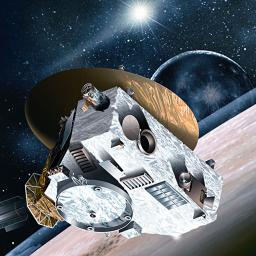
The dramatic images of vast ice plains on Pluto beamed to Earth last week prove that it is regions on the edge of the solar system - long thought to be inert wastelands - that are the most exciting for scientistsFor a world perched at the outer edge of the solar system, Pluto caused considerable excitement last week when it was revealed to be a place of unexpected dynamic activity. The New Horizons probe – after a 10-year voyage to reach the dwarf planet – was able to show that it contains great plains of ice that could have formed only 100 million years ago, a mere twinkling of a cosmic eye. Continue reading...
|
 |
by Jon Butterworth on (#EQMG)
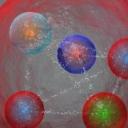
Almost - but not quite - buried on the icy plains of Pluto this week, the Large Hadron Collider revealed a completely new type of particle. What does that tell us?
|
 |
by GrrlScientist on (#EQ6A)
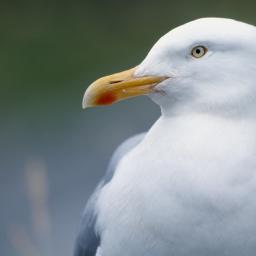
Instead of singing for her supper, this brilliant gull dances and is rewarded with a bellyfull of deep-fat fried chipsToday’s “Caturday†video features a herring gull that has invented an ingenious way to be fed as many chips as she could possibly ever want. Instead of singing for her supper, this bird “dances†for her supper. Continue reading...
|
 |
by David Shariatmadari on (#EPKQ)
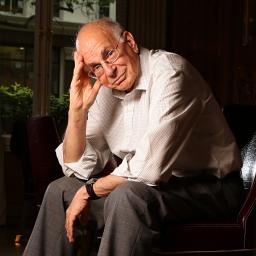
The psychologist and bestselling author of Thinking, Fast and Slow reveals his new research and talks about prejudice, fleeing the Nazis, and how to hold an effective meetingDaniel Kahneman is the very definition of unassuming: a small, softly spoken man in his 80s, his face and manners mild, his demeanour that of a cautious observer rather than someone who calls the shots. We meet in a quiet spot off the lobby of a London hotel. Even then I have trouble catching every word; his accent hovers between French and Israeli and his delivery is quiet, imbued with a slightly strained patience, helpful but cautious.And yet this is a man whose experimental findings have shifted our understanding of thought on its axis – someone described by Steven Pinker as “the world’s most influential living psychologistâ€. With his long-time collaborator Amos Tversky, who died in 1996, he delineated the biases that warp our judgment, from figuring out if we can trust a prospective babysitter to buying and selling shares. In 2002 he was awarded the Nobel prize in economics, a testament to the boundary-busting nature of his research. Continue reading...
|
by Guardian Staff on (#EN8N)
Nasa's New Horizons team displays a 'flyover' graphic animation of what the mountains and plains of Pluto look like from high above. Principal investigator Alan Stern unveiled the images of 'the icy frozen plains of Pluto" adjacent to 11,000ft-high mountains
 |
by Alan Yuhas in New York on (#EN7H)
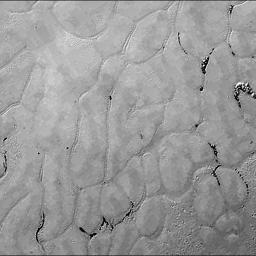
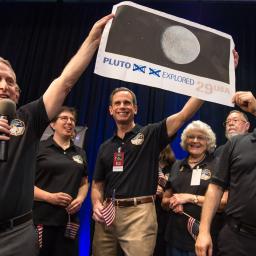
‘I think the solar system saved the best till last’ says lead investigator as Nasa states only 1-2% of data from mission to dwarf planet has been downloaded so farPluto has giant plains threaded with trenches and studded with hills, Nasa revealed on Friday, as researchers of the New Horizons mission released a new image of the surface and discussed the findings of the growing data they are gathering from the dwarf planet.
|
 |
by Letters on (#EN04)
Simon Jenkins parrots a cry that I have heard a few times during my career as a research scientist in high-energy physics (Pluto trumps prisons when we spend public money, 17 July). He is unimaginatively concerned that the £34m a year spent by the UK at Cern (and a similar amount per year would have been spent on the New Horizons probe to Pluto) is not actually money well spent.Yet I read his article online using the world wide web, which was developed initially by and for particle physicists. I did this using devices with integrated circuits partly perfected for the aerospace industry. The web caused the longest non-wartime economic boom in recorded history, during the 90s. The industries spawned by integrated circuits are simply too numerous to count and would have been impossible to predict when that first transistor was made in the 50s. It is a failure of society that funnels such economic largesse towards hedge-fund managers and not towards solving the social ills Mr Jenkins rightly exposes. Continue reading...
|
 |
by Greg Dash on (#EMTF)
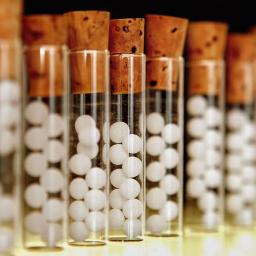
Those attacking Jeremy Corbyn for supporting the NHS provision of homeopathy are helping to entrench the perceived elitism of mainstream medicineThis week, critics of Jeremy Corbyn dug up a 2010 tweet in which he justified his signing of a parliamentary motion in favour of NHS provision of homeopathic treatments (his voting record, including votes in favour of scientific funding and against the use of the designation of “doctor†for complementary therapists is available here).Although I am not a proponent of homeopathy, the response to this “revelation†has been discouraging. In particular, Ian Dunt of politics.co.uk used belief in homeopathy as a test not only for idiocy, but also for morality. Dunt suggests that in holding a belief in homeopathy (or any other “enemy of objective truthâ€), proponents are showing that they fail to understand the world and rejecting objectivity in favour of experiential evidence or intuition. Continue reading...
|
 |
by Guardian Staff on (#EMRW)
Video has emerged of a colourblind man experiencing some colours for the first time - thanks to the help of a special pair of glasses. Ethan Zachery Scott, from Los Angeles, is filmed trying on the glasses, given to him as birthday present by his fiancé. Scott is moved to tears by the new array of colours, especially purple Continue reading...
|
 |
by Oliver Burkeman on (#EM8Y)
As a recent study proves, turning anything fun into a chore can ruin it, so how can we enjoy things without the obligation trap?A new study of the link between sex and happiness has been getting lots of media attention – presumably because it’s about sex, and for the staff of traffic-hungry media organisations, the experience of receiving vast numbers of clicks on a story about sex is, ironically and poignantly, better than sex. The headline finding is that more sex doesn’t automatically make you happier; in fact, contrary to the assumptions of most researchers, and for that matter most sex-havers, it makes many feel worse.Here’s how the experiment worked: half of the 128 couples involved were instructed to have twice as much sex as usual, then all participants filled out a survey, about their sex lives and happiness levels, every day for three months. Perhaps you can spot the problem here? (To be fair, the study’s authors were well aware of it.) A better way of putting the results might be as follows: when four academics from Carnegie Mellon University in Pittsburgh tell you to have more sex, and fill out a tedious form every day, it doesn’t make you happier. Continue reading...
|
 |
by Hannah Devlin science correspondent on (#EM2Y)
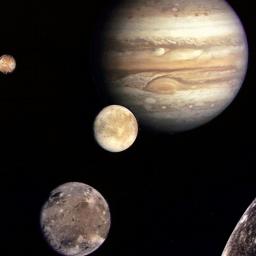
A new world of space exploration is unfolding over the next few years, from the ExoMars robot drilling to asteroid exploration, the ESA’s mission to Jupiter’s icy moons and the Solar Orbiter
|
 |
by Tomas Chamorro-Premuzic on (#EKEE)
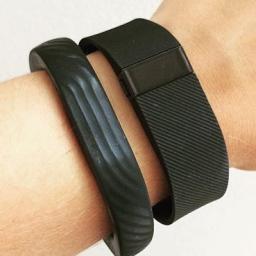
Self-tracking apps and devices allow us to monitor our behaviour, but we should be cautious in expecting them to drive improvements in our wellbeing“Fitter, happier, more productive†is a cynical line even by Radiohead’s standards. But the band’s song, released in 1997, did manage to predict the near future: an explosion of apps and wearable devices devoted to monitor people’s lives with the purpose of boosting self-control and suppressing naughty habits. This movement, referred to as the quantified self, revolves around enhancing self-knowledge through numbers, in particular data capturing our everyday behaviours, habits and activities.As the Economist noted when the trend began to make waves, its users “are an eclectic mix of early adopters, fitness freaks, technology evangelists, personal-development junkies, hackers and patients suffering from a wide variety of health problems. What they share is a belief that gathering and analysing data about their everyday activities can help them improve their lives – an approach known as self-tracking, body hacking or self-quantifying.†Continue reading...
|
 |
by Joel Golby on (#EK9V)
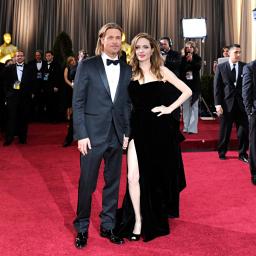
From Brangelina to Brexit, the ugly mating of elegant words has gone too far. So don’t be a Camerunt: cease portmanteauing immediatelyA little party trick I use to bore girls is to pepper them with exceptionally dry factlets about the English language. It involves me saying things like: “Yo hey what up: did you know the reason we have a different word for the flesh of an animal and the animal itself is because of the French invasion of 1066, when French became the language of the courts, and they made many decadent boeuf dishes?†I wiggle closer and say: “Did you know there is a direct line between the plague and the invention of the aspirational middle class and the invention of thesauruses? That the plague basically caused thesauruses?†Lean right in and say: “Do you know about William Labov’s department store study, because it is actually very interesting?†This approach, I don’t mind telling you, has a 100% success record – at boring them.But I’ve found my niche now, Guardian readers, in you, and you cannot pretend you have a boyfriend or sprint away to an awaiting Uber so let’s talk about portmanteaus, shall we? Portmanteau words – imagine I am sliding a single vodka-coke towards you right now – portmanteau words are two words shunted together, like a cut-and-shut car. They are fun. Continue reading...
|
by Ian Sample on (#EK2G)
Professor Robert Plomin on the role genetics play in children's successWould true equality in education mean testing children's genetics at the age of four, so that any learning difficulties revealed can be accommodated right from the start of primary education?Robert Plomin is professor of behavioural genetics at King's College London. He's the co-author with Kathryn Asbury of G is for Genes: the Impact of Genetics on Education and Achievement. Continue reading...
 |
by Joshua Robertson on (#EK15)
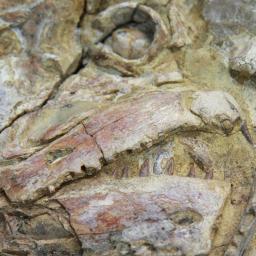
The skull of a giant predator fish called cooyoo reveals its formidable teeth and massive jawRelated: Dinosaur comes out of closet at South Africa universityThe discovery of 100 million-year-old fossils in outback Queensland has shed new light on creatures from Australia’s ancient inland sea.
|
 |
by Andrew Holding on (#EJZB)
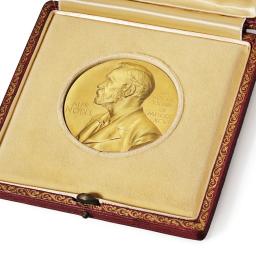
When a public figure makes a mistake, there’s probably something we can all learn from itThree years ago, I was working alone in the lab when the phone rang. On the other end, much to my surprise, was a Nobel prize winner asking to collaborate. That phone call led to a successful research project, the results of which were published earlier this year.I recall the initial meeting we had, and voicing my concerns as to how I would be credited in the final publication - should it be successful - as it would require a reasonable amount of my time and access to methods that I was still in the process of developing. His answer was simple: look at his publication record and I would see he treats his collaborators well. Something I too can now attest. This kind of discussion is normal between scientists to establish boundaries; but importantly, the differences in the stages of our careers and our accolades never came into the discussion. Instead, any credit was discussed on the merits of what each of us could contribute to that specific piece of research. Continue reading...
|
 |
by Associated Press on (#EJPP)
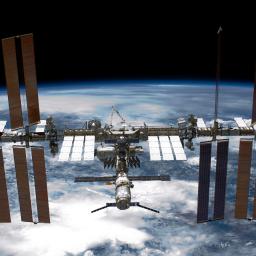
Safety protocol put in place for only the fourth time in 16-year history of ISS as crew seeks protection from potentially lethal space debrisA piece of space junk threatened to crash into the international space station, forcing the three astronauts to seek emergency shelter.For nearly an hour on Thursday, the American and two Russians hunkered down in their Soyuz capsule, which is docked to the space station, in case they had to make a quick getaway. The fragment from an old Russian weather satellite ended up passing harmlessly, about 1½ miles (3kms) away. Continue reading...
|
 |
by Stuart Clark on (#EJF6)
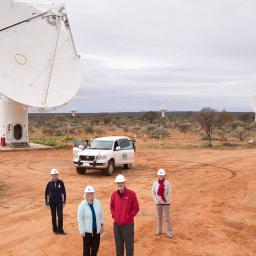
The SKA, which will be split between sites in Australia and South Africa, will peer back into the ‘dark ages’ of the universe. No one knows what it will find there• Radio silence in Western Australia for most powerful telescope in historyThe Square Kilometre Array (SKA) is a huge project designed to sweep away many of the current roadblocks to astronomical progress. These include searching for the first celestial objects to form in the universe, investigating whether we need to develop a new theory of gravity, and looking for the building blocks of life in space.After the big bang around 13.8bn years ago, the universe was nothing but a vast cosmic ocean of gas. There were no stars or planets. Nothing was shining and astronomers refer to this time as the dark ages. During this time, matter was gradually pulling itself into the first celestial objects, but no one knows what these objects were. Continue reading...
|
 |
by Emily Wilson on (#EJF8)
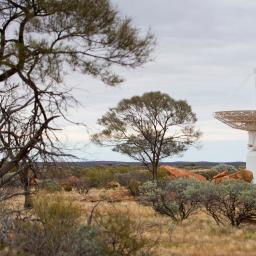
On a former cattle farm in the remote outback, scientists are laying the ground for the biggest science project of the next 20 years: a radio telescope capable of picking out something like an airport radar on a planet in another solar system. Turn on your phone at your peril, because preserving radio quiet here is priority number one• The world’s most powerful radio telescopeIn outback Western Australia, around 350k northeast of the small town of Geraldton, lies an area of land about the size of the Netherlands, but with only 100 humans living in it: the shire of Murchison.The land looks beautiful but far from unusual as you head up the long red road north – mostly pancake flat and scrubby, with here or there the spark of a winter flower, a kangaroo or a sudden, luminous outcrop. Continue reading...
|
 |
by Letters on (#EHKT)
As a physicist, I never cease to be amazed by the miraculous insights that continue to be garnered via scientific exploration (Pluto: the furthest frontier, 16 July). To successfully send a spacecraft billions of miles away to photograph and study a tiny, forbidding, cold and alien body demonstrates how far the human race has come. If only our leaders would set their sights on furthering the human race rather than destroying it, one could only imagine how far we may travel in the future.
|
by Suzanne Goldenberg on (#EHD0)
Seas will continue to warm for centuries even if manmade greenhouse gas emissions were frozen at today’s levels, say US government scientistsThe warming of the oceans due to climate change is now unstoppable after record temperatures last year, bringing additional sea-level rise, and raising the risks of severe storms, US government climate scientists said on Thursday.The annual State of the Climate in 2014 report, based on research from 413 scientists from 58 countries, found record warming on the surface and upper levels of the oceans, especially in the North Pacific, in line with earlier findings of 2014 as the hottest year on record. Continue reading...
 |
by Simon Jenkins on (#EH8Q)
Stephen Hawking’s right: we explore because we’re human. But those who shout the loudest will get the most money, regardless of the social dividendThe two headlines were next to each other. “Prisons worst for 10 yearsâ€, and “Snow on Plutoâ€. The juxtaposition may seem unfair, but how to react? Presumably to the first with anger, and the second with excitement. Compared with the remorseless grime of humans, astronomy offered an escape, a cause for joy, a vision of futurity. Stephen Hawking congratulated the Pluto team. “We explore because we are human beings,†he said, “and we want to know.â€The trouble is that those baffled by Britain’s obsession with incarceration might say the same. Each week we tip more people into prison and treat them a little worse. We know it is a waste and doesn’t work, but don’t know why or what to do about it. Continue reading...
|
 |
by Hannah Devlin science correspondent on (#EH4S)
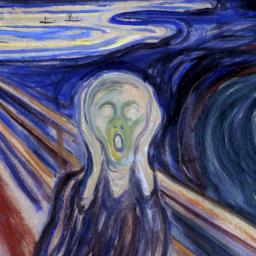
Study on human screaming at New York University reveals how rapid rate of wide unperceived volume changes or ‘roughness’ elicits emotional responseHuman screams have a unique acoustic property that triggers the brain’s fear centre more effectively than almost any other sound, scientists have found.After testing a variety of noises, including human speech and musical instruments, the only other sounds that appeared to activate the brain in a similar way were car alarms and police sirens, the study found – perhaps explaining why they are so unpleasant to listen to and almost impossible to ignore. Continue reading...
|
 |
by Guardian staff on (#EGX9)
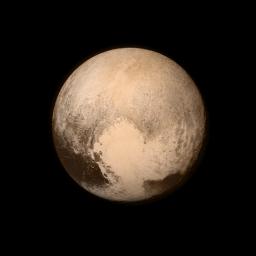
The photos of Pluto this week were the latest in a long line of first shots taken of the planets in our solar system Continue reading...
|
 |
by Guardian Staff on (#EGXB)
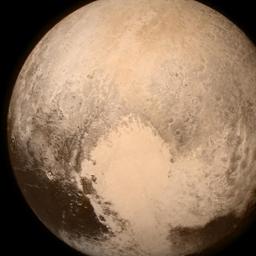
Nasa unveils a sequence of images that show how human understanding of Pluto has evolved since the 1930s. On Wednesday night, the dwarf planet was revealed in a high-resolution image for the first time in a picture taken by Nasa's New Horizons spacecraft. Pluto was once considered an icy, dead world – but the images reveal signs of geological activity Continue reading...
|
 |
by Ian Sample science editor on (#EGNQ)
Beautifully preserved skeleton fossil discovered of raptor two metres long with impressive plumage that lived 125m years ago in northeastern China
|
 |
by Suzanne Goldenberg in Toronto on (#EGJA)
With Shell planning to begin drilling in the Chukchi Sea within days, Gore said that Obama was wrong to ever allow drilling in the ArcticThe former US vice-president and climate champion Al Gore has made a rare criticism of Barack Obama as Royal Dutch Shell prepares to drill an exploratory well in the Arctic Ocean, denouncing the venture as “insane†and calling for a ban on all oil and gas activity in the polar region.With Shell planning to begin drilling in the oil-rich Chukchi Sea within days, Gore said in an interview with the Guardian that Obama was wrong to ever allow drilling in the Arctic. Continue reading...
|
by Alex Bellos on (#EG6F)
Why I built Britain’s first elliptical pool table, for the game of LOOP, which will have its inaugural championship at the Port Eliot Festival later this month.When I began writing about maths I had no idea that it would lead me to the glamorous world of indoor sports.But while I was researching my most recent book I became entranced by the ellipse, the curve that you see whenever you look at a circle side-on. Continue reading...
 |
by Hannah Devlin Science correspondent on (#EEFC)
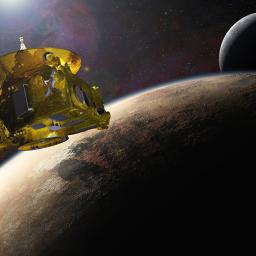
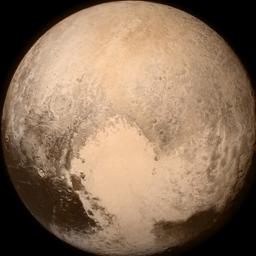
Mission culminates in images of former ninth planet that show mountain ranges of ice and suggest surface has recently been ‘paved over’ by geological activityFor 85 years, it was little more than a featureless grey blob on classroom maps of the solar system. On Wednesday night, Pluto was revealed in high resolution for the first time, revealing dramatic mountain ranges made from solid water ice on a scale to rival the Alps or the Rockies.The extraordinary images of the former ninth planet and its large moon, Charon, beamed 4 bn miles back to Earth from the New Horizons spacecraft, marks the climax of a mission that has been quietly underway for nearly a decade. Continue reading...
|
 |
by Hannah Devlin Science correspondent on (#EEQF)
Spacecraft clocked fastest launch speed, recorded first video of volcanic eruption off Earth and carries the ashes of the man who discovered the dwarf planet
|
 |
by Nikki Stevenson on (#EFQB)
Mainstream theory presents autism as an “epidemicâ€, disease or deficit. But what about the strengths and abilities that can be found within the spectrum?Autism may represent the last great prejudice we, as a society, must overcome. History is riddled with examples of intolerance directed at the atypical. We can sometime fear that which diverges from the “normâ€, and sometimes that fear leads us to frame those who are different as being in some way lesser beings than ourselves.Intolerances take generations to overcome. Racism is an obvious, ugly example. Other horrifying examples are easy to find: take, for instance the intolerance faced by the gay community. Countless gay people were diagnosed with “sociopathic personality disturbance†based upon their natural sexuality. Many were criminalised and forced into institutions, the “treatments†to which they were subject akin to torture. How many believed they were sociopathic and hated themselves, wishing to be free from the label they had been given? How many wished to be “cured†so that they could live their lives in peace? The greatest crime was the damage perpetuated by the image projected upon them by those claiming to be professionals. Continue reading...
|
 |
by Dan Eatherley on (#EFKD)
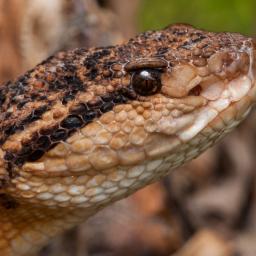
The four species of bushmaster, found in the rainforests of Central and South America, are the world’s longest vipers. Naturalist Dan Eatherley tells the captivating story of Lecky, “the Mahatma Gandhi of reptilesâ€Name: Lecky
|
 |
by Phil Gates on (#EFD3)
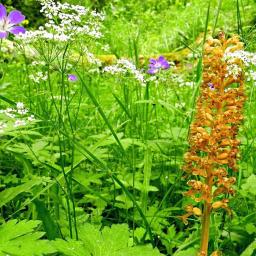
Weardale, County Durham: With no leaves or chlorophyll the plant’s survival depends upon a complex ménage à troisIt is 15 years since we last discovered a bird’s-nest orchid. It was hidden among dog’s mercury in an old hazel coppice. The withered brown flower spike was well past its best but its botanical charisma more than compensated for a lack of beauty.This is an orchid that challenges preconceptions of how a plant can be defined. With no leaves and no chlorophyll, its survival depends on a single species of fungus that also forms a symbiotic association with nearby trees. The trees supply the fungus with sugars and extract minerals from it. Continue reading...
|
 |
by Guardian Staff on (#EF0B)
Devastating terrorist attacks which cause structures to collapse are helping researchers come up with safer building plans. The 11 September 2001 attacks on the World Trade Centre, as well as the Oklahoma City bombing in 1995, are just two which have been studied at the University of New South Wales to help researchers in their quest for more stable structures.
|
 |
by Jessica Lee in New York on (#EEMA)
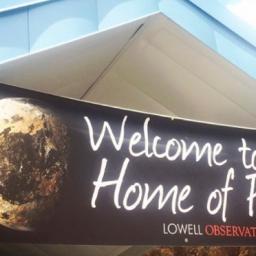
In the small Arizona town where Pluto was spotted in 1930, more than 1,000 residents gathered to celebrate the Nasa mission: ‘It was total pandemonium’As Nasa’s New Horizons mission made first contact with Earth with dazzling photos of the dwarf planet more than 3bn miles away, one small town in northern Arizona was abuzz like no other.Related: Pluto pictures: Nasa reveals first high-resolution images of planet's surface Continue reading...
|
 |
by Guardian Staff on (#EEK6)
Nasa unveils new high resolution photographs and data sent back to Earth from the New Horizons spacecraft of Pluto and its moons. Among the images are the first ever close-up of Pluto's surface, the first high resolution image of Charon, the dwarf planet's largest moon, and a grainy but revealing image of Hydra, another of its moons Continue reading...
|
 |
by Adam Roberts on (#EEHR)
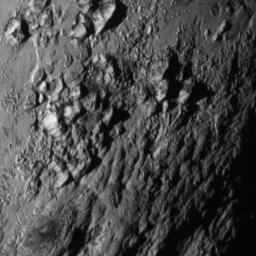
New Horizons could have spoiled our imaginative view of Pluto by revealing nothing very special – instead it has uncovered all sorts of amazing thingsWe have all been marvelling at the New Horizons images of Pluto – 134340 Pluto, to give it its official, rather distractingly Beverley Hills 90210-ish designation. And we marvelled with good cause.The whole mission is marvellous. I have difficulty navigating my left foot into my left trouser leg first thing in the morning, yet somehow human beings like me managed the extraordinary feat of shooting a robot the size and shape of a grand piano 3bn miles through space to fly so close past Pluto it could virtually kiss the surface. Continue reading...
|
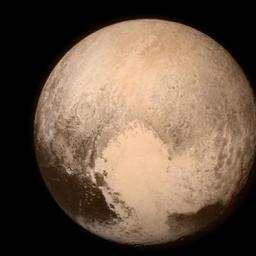 |
by Alan Yuhas in New York on (#EE3T)
Team at Nasa unveils and describes new high-resolution photographs and data sent back to Earth from the New Horizons spacecraft of Pluto and its moons4.19pm ETWe’re going to close our live coverage of the New Horizons mission to Pluto with a quick summary of Nasa’s most recent revelations from the edge of our solar system.4.02pm ETThere’s something about these two worlds that’s “very very different,†Stern says. One has an atmosphere, the other doesn’t, one is covered in water ice, the other in volatiles (a category of active chemicals).“It’s a puzzle, it’s a real puzzle.†Continue reading...
|