by Rajeev Syal on (#BHP4)
Contrary to Nobel laureate’s remark, quickly defended by London mayor Boris Johnson, Prof Ad Vingerhoets says his study found women wept less at work
| Link | http://feeds.theguardian.com/ |
| Feed | http://feeds.theguardian.com/theguardian/science/rss |
| Updated | 2026-10-01 03:45 |
 |
by Ian Sample Science editor on (#BGW1)
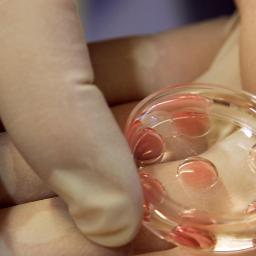
Twelve-year project advises donor eggs be recommended to women in mid-40s but says steep decline in birth rates could be avoided by freezing eggs before 35Women should be advised to have IVF with donor eggs instead of their own when they reach the age of 44 to boost their chances of success, fertility doctors have said.Researchers in Spain found that the chances of women having a baby through IVF was only 1.3% in those aged 44 and above, but stood at 24% in those aged 38 to 39. Continue reading...
|
 |
by Alan Yuhas in New York on (#BGHR)
In previewing missions in the search for life and discussing its challenges, the scientists confess they ‘can’t even agree on a definition of what life detection is’Nasa scientists previewed several missions in the search for life off Earth on Tuesday, including a plan to scoop up minerals from an asteroid and one to drill into the surface of Mars.The missions described by researchers included satellites, spacecraft, landers and work concentrated on Mars, Jupiter moons, an asteroid and on Earth itself. Continue reading...
|
 |
by Letters on (#BGAH)
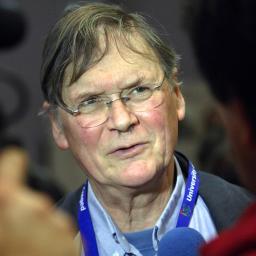
Now that there has been time for some quiet reflection, I feel I must raise a voice against the tsunami of opprobrium that has fallen on Prof Tim Hunt. I, like most other feminists, was appalled by what he said, but the action of UCL in effectively dismissing him was surely excessive (Scientist quits after sexism row, 11 June). Who among us can pretend we have never said anything foolish? Prof Hunt has apologised unreservedly, and the best response to his statement about women in laboratories was that of the Twitter campaign #distractinglysexy (Report, 13 June), which was both to the point and very funny indeed.Who is served by Prof Hunt’s hounding out of the academic community? He is a Nobel prize winner and, as such, surely still has a contribution to make to science and, thereby, society. I urge UCL and the other institutions from which he felt required to resign to call him back. Continue reading...
|
 |
by Syreeta McFadden on (#BFXW)
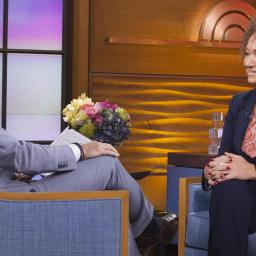
To deny ethnic and cultural differences is to erase the identities of those who cannot chooseAfter days of speculation, Rachel Dolezal appeared on the Today show and declared herself transracial – and blamed other people’s misunderstanding of the term on why she came to be identified as black. “I was actually identified when I was doing human rights work in north Idaho as first transracialâ€, she said – in a construction that conveniently negated her agency in that decision – and explained that she never corrected subsequent media reports that she was biracial or black.“I identify as blackâ€, she said during the interview, though she admits to having identified as white at other points – including when she sued Howard University for racial discrimination because she was white. (She lost.) Continue reading...
|
 |
by Sarah Boseley Health editor on (#BFXY)
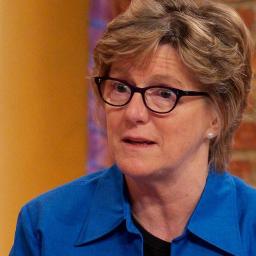
Sally Davies writes to Royal Academy of Science in wake of negative press and public concern regarding the drugsThe chief medical officer, Sally Davies, has requested an expert review to shore up public confidence about the safety and effectiveness of medicines, in the wake of controversy around statins and Tamiflu.Davies wrote to ask the Royal Academy of Science if it would undertake the work. “I am very concerned about the lack of resolution of the statins and side-effects issues in both the medical and general press,†she said. Continue reading...
|
 |
by Press Association on (#BFDK)
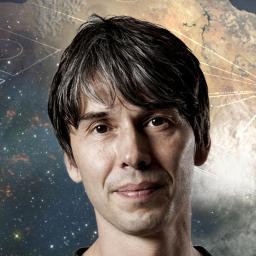
Broadcaster says lack of women in science is a problem but criticises UCL for ‘hounding out’ Nobel laureate as part of wider problem of ‘trial by social media’The scientist and broadcaster Prof Brian Cox has said it was wrong the way a Nobel laureate scientist was “hounded out†of his university post over controversial comments he made about women working in laboratories.
|
 |
by Guardian Staff on (#BFAK)
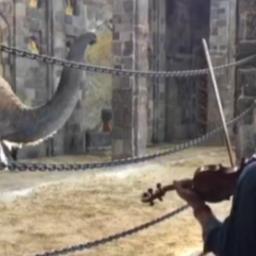
A Belgium zoo captures footage of a group of elephants appearing to sway in unison to live classical music. Violinists were asked to play to the elephants, and other animals at the Pairi Daiza zoo, to ensure they were not disturbed by the music, ahead of a series of live music nights at the sanctuary. Far from disturbed, the elephants appear to sway their trunks and bodies in time with the music Continue reading...
|
 |
by Ian Sample Science editor on (#BF27)
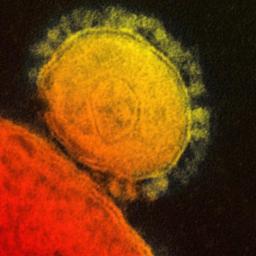
Victim succumbed to a lung disease after recovering from the infection he is believed to have contracted from a camel in the UAEA 65-year-old man has died in Germany from medical complications after being treated for the Mers-CoV virus that has spread through the Middle East and spilled out to other regions.The man is believed to have contracted the virus from an infected camel during a visit to a livestock market in the United Arab Emirates in February.
|
 |
by Stuart Clark on (#BENW)
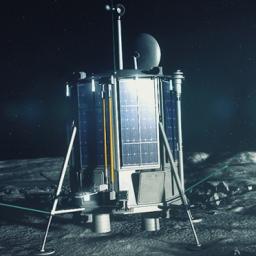
The United Nations is taking an interest in the commercially funded Lunar Mission One project. Could commercial space enterprises open the door to fully international space missions?If it works, Lunar Mission One will be a game changer. Instead of relying on governmental organisations such as the European Space Agency (ESA) or Nasa to fund science, Lunar Mission One is a privately-funded space science mission.Anyone from individuals to governments will be able to buy into the mission. It aims to land at the moon’s south pole in 2024 and drill into the lunar interior for answers about how the whole solar system formed.
|
 |
by Press Association on (#BEB9)
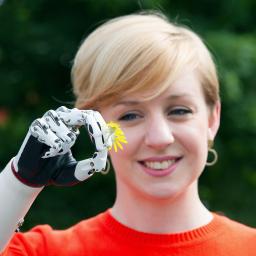
Nicky Ashwell, 29, from London, can now carry out tasks with both hands for first time with hand developed by prosthetic experts SteeperA British woman has been able to ride a bike for the first time after being fitted with what has been described as the world’s most lifelike bionic hand.Nicky Ashwell, 29, from London, can now carry out tasks with both hands for the first time, but said it is the little things she can now do that surprise her the most. Continue reading...
|
 |
by Reuters in Cape Canaveral on (#BDH4)
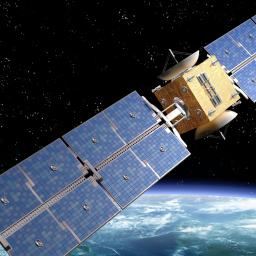
Project partly funded by Richard Branson’s Virgin group aims to create global communications network, launching the first of its orbiting fleet in 2018Airbus will design and build about 900 satellites for privately owned OneWeb, which plans to offer high-speed, space-based internet access to billions of people worldwide, company officials have announced.
|
 |
by Agence France-Presse on (#BDDP)
British scientists searching for evidence of Norse colonisation in the communities of the Cotentin peninsula warn of ‘sensitivities’ over the issueBritish researchers on Monday began collecting the DNA of residents from Normandy in northern France in search of Viking heritage, but the project has raised concerns amongst some local anti-racism activists.Around a hundred volunteers from the Cotentin peninsula area are giving DNA samples to academics at the University of Leicester, who are trying to find descendants of the Vikings who invaded what is now Normandy in the 9th century. Continue reading...
|
 |
by Agence France-Presse in Paris on (#BD4R)
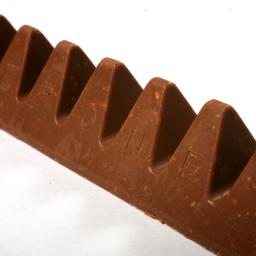
Study of 21,000 people finds rate of heart disease and stroke decreased with amount eaten up to modest limits, but scientists warn it may not be a direct linkNew research has added to tentative evidence that eating chocolate in modest quantities may be good for the heart.
|
 |
by Press Association on (#BD3P)
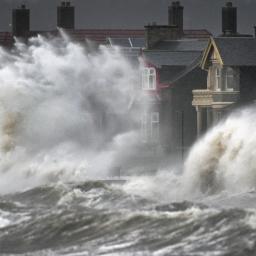
Study of UK weather from 1980 to 2012 pinpoints location between London and Berkshire as hotspot for weather phenomenonAn area between London and Reading in Berkshire is the most likely part of Britain to be hit by a tornado, according to a team from the University of Manchester. Using witness reports of UK twisters over a 32-year period, the scientists found the area most likely to be struck was west and south-west of London, which had a “6% chance per year of a tornado occurring within 10km of a given locationâ€. But they also described this as a “one in 17-year eventâ€.The UK experiences on average 34 tornadoes a year, the most per area of land mass in the world, the scientists said. The strongest seen were categorised as F2 on the Fujita scale used to assess their power, with winds of up to 157mph, compared with the F5 storms seen in the US, where winds can exceed 300mph. Continue reading...
|
 |
by Sarah Boseley on (#BCZE)
Data on one million teenagers shows marijuana use did not increase in US states where it was legalised, with fall among youngest children, authors of study findLegalising the medical use of cannabis has not led to a surge in the numbers of adolescents using it in the USA, according to new research that surprised its authors and will encourage those hoping for relaxation of the law elsewhere.Since 1996, 23 US states and the District of Columbia (DC) have approved the medicinal use of cannabis. In the states of Colorado, Washington, Alaska and Oregon and DC, recreational use is also legal. These moves towards permissiveness, even where possession of the drug is restricted to medical use, have caused many critics to worry that cannabis use would rise, especially among teenagers. Continue reading...
|
 |
by Mariana Mazzucato on (#BC3N)
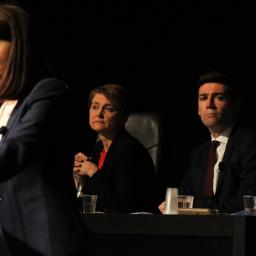
Mariana Mazzucato argues that, in its search for a new leader, the Labour party also needs a new story about innovation, the economy and wealth creation
|
 |
by Philip Ball on (#BBJA)
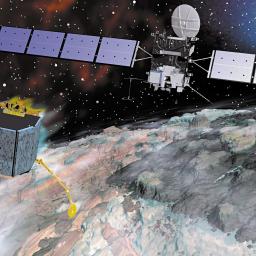
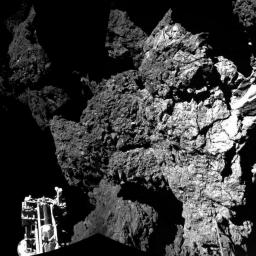
From Voyager to Rosetta, I’ve balked at the personification of unmanned space missions. But if it ends our obsession with human spaceflight, I say go for it“I’m awake! How long have I been asleep?†This message was tweeted on Sunday by the European Space Agency’s spacecraft Philae. The probe tumbled into a dark ditch on a comet last November after problems landing on the icy surface. Deprived of sunlight, Philae’s solar panels were unable to supply power, and the craft was feared lost. But Philae’s resurrection, as the comet moves nearer the sun and receives more light, has amazed and galvanised not just the scientists conducting the mission, but also public interest the world over.But of course Philae didn’t wake up, nor did it tweet to that effect. Philae is not “pluckyâ€, it is not R2D2 or Wall-E: it is a machine designed to examine a comet, equipped with just a tiny fraction of the computer power in your mobile phone. Sorry about that. Continue reading...
|
 |
by Hannah Ewens on (#BBBH)
The persisting prejudice against crying on the job doesn’t fit in today’s office environmentI will never forget the first time I needed to cry at work. But crying is looked down upon in the workplace as oversensitive, immature and unprofessional – the most recent example of male disdain came this week, when Nobel laureate Tim Hunt suggested that female scientists can’t take criticism without crying. So I held in my distress, and it built until, unable to conceal it anymore, I ran to the bathroom, threw up my breakfast and cried until I could return to my desk.As someone dealing with an anxiety disorder, feeling that I couldn’t show emotion at the office just exacerbated my emotional and physical reaction to the situation. As an advocate for a good, cathartic sob, I say that the persisting prejudice against crying doesn’t fit in today’s work environment.
|
 |
by Benjamin Lee on (#BAAT)
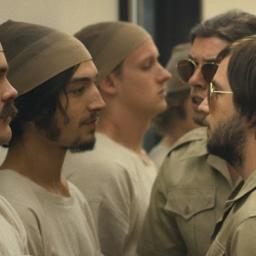
The controversial psychological study from the 70s gets the big screen treatment as volunteer prisoners and guards go to battleIt was one of the most controversial psychological studies ever recorded and has already led to two feature films and a BBC reality series.Related: Sundance 2015 review – The Stanford Prison Experiment: notorious behaviour test becomes masterful film Continue reading...
|
 |
by Sylvia McLain Alison Woollard on (#BA5F)
If Britain cares about science, it must vote against BrexitLeaving the EU would be an unmitigated catastrophe for British science. The UK government spends less than 0.5% of its GDP on science - ensuring that the UK scrapes the bottom of the G8 science funding barrel by some margin. Now, some folks in the government appear to want to further debilitate UK science by allowing voters to decide whether we quit the EU. Perhaps science isn’t one of the first things the government thinks of when it’s making noises about a European referendum, but it absolutely should be.First and foremost – it’s the economy, stupid. UK science is one of the fundaments of the modern British economy. Oxford Economics’ conservative estimation is that the innovation, research and technology sectors contributed around £7.6 billion in gross value added to the UK economy in 2012/13, and that for every £1 spent on science-related fields, the overall return to the wider UK economy is around £4–£7. For a government running a deficit, you would think that using science to help build the economy should be more of a priority. Continue reading...
|
 |
by Dominic Burgess on (#BA5H)
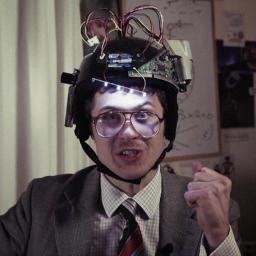
Cleverclogs brainbox Jeremy Bumble is on a mission to teach the world everything he knows about the miracles of modern science. First on his knowledge-dissemination hitlist: Moore's Law – what it means, where it came from and where on earth it's going. Go science! Continue reading...
|
 |
by Helen Davidson on (#BA48)
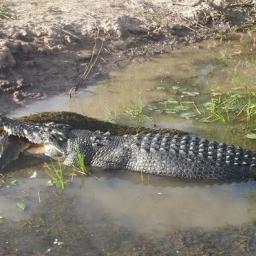
When Maxi, a 4.5m long saltwater crocodile, fought with a smaller saltie, there was only ever going to be one winner. Afterwards, the dominant croc holds its kill in the water until it is completely still. It is rare to witness this behaviour, even though the crocodiles of the Northern Territory's Yellow Water Billabong are territorial by nature Continue reading...
|
 |
by Edward Bloomer, Royal Observatory Greenwich on (#B926)
Because of their enormous distance from us, the stars remain stationary with respect to each other (at least during the span of a human lifetime), creating the celestial sphere – an imaginary sphere of arbitrary size on which you can paint the locations of these fixed objects.A coordinate system, right ascension and declination can be defined using the celestial sphere, counterparts of longitude and latitude on Earth. In theory, we can trace the motion of moving objects with respect to this system: planets, asteroids comets … Continue reading...
|
 |
by Assocated Press in Honolulu on (#B8SJ)
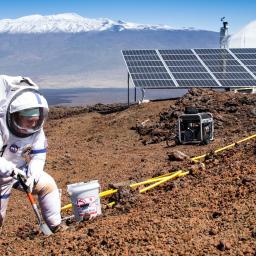
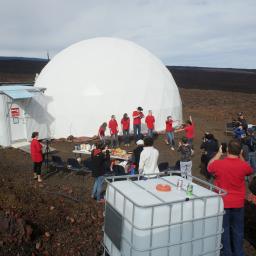
Six crew members in Nasa-sponsored study venture outside dome on dormant Hawaii volcano after eight months of close-quarters livingSix scientists who were living under a dome on the slopes of a dormant Hawaii volcano for eight months to simulate life on Mars have emerged from isolation.The crew stepped outside the dome 2,400m (8,000ft) up the slopes of Mauna Loa to feel fresh air on their skin on Saturday. It was the first time they left without donning a space suit. Continue reading...
|
 |
by Jamie Grierson on (#B8A5)
Spacecraft makes contact with scientists for first time in seven months after losing power following touchdown on comet 67P/Churyumov-GerasimenkoFrom aliens bursting forth from crew members’ chests to onboard computers developing a psychopathic mind of their own, waking from space hibernation rarely results in a happy ending. But a real-life space voyage has bucked the trend of science-fiction counterparts such as Alien and 2001: A Space Odyssey, as one of humankind’s greatest achievements “woke up†to the great relief of its earthbound masters.Philae, the first spacecraft to land on a comet, phoned home and made contact with the European Space Agency (ESA) for the first time in seven months on Saturday. In a series of whimsical messages, ESA scientists revealed contact had been re-established with the probe through the Philae lander and Rosetta mission’s Twitter accounts. Continue reading...
|
 |
by Greg Whitmore on (#B7HD)
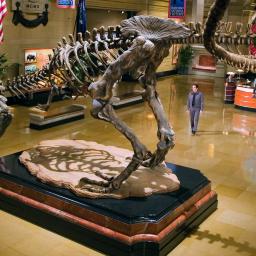
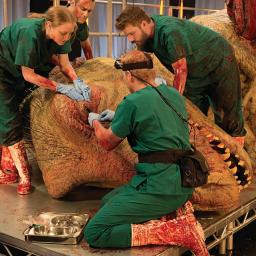
Hollywood’s first big dinosaur movie, The Lost World, was released 90 years ago. Jurassic World has just hit the big screen. Two great reasons for us to pay homage to our favourite clay, rubber and computer-generated prehistoric creatures and the pioneers who created them Continue reading...
|
 |
by David Derbyshire on (#B7HF)
Critics of new film Jurassic World say that the prehistoric creatures look wrong. But how much do we really know about dinosaurs – and when it comes to portraying them on screen, does it matter anyway?If you ever feel the urge to see well-intentioned dinosaur wrongness in all its glory, take a trip to Crystal Palace Park in south London. Lurking among the trees, shrubs and ponds, you will find the original Jurassic Park – a spectacular Victorian collection of prehistoric creatures in iron and concrete.The 30 statues were the centrepiece of a geological theme park opened in 1854 under the supervision of Richard Owen, the anatomist who had coined the word “dinosaur†12 years earlier. Brought to life by artist Benjamin Waterhouse Hawkins and based on the latest scientific discoveries, they were the first life-size model dinosaurs and the public loved them. Sadly, history hasn’t been kind to Owen’s endearing, but widely inaccurate, creations. Continue reading...
|
 |
by Interview by Nicola Davis on (#B7FH)
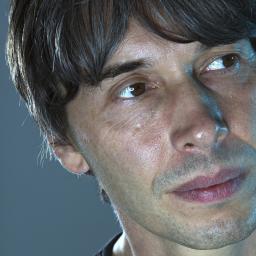
The new face of science at the Royal Society talks about taking on Einstein, TV versus teaching, and why not everything he posts on Twitter should be taken seriouslySummer’s here, students are heading off – what are you working on?The last paper I published was a really theoretical paper with three colleagues and it was stimulated by a popular book I wrote with Jeff Forshaw about quantum mechanics. [There is] this strange feature of quantum theory that it appears to not care about Einstein’s theory of relativity – it does care about it but it appears that you can do things at some place in the universe and in principle the whole universe seems to respond. We got interested in using all the modern machinery of quantum field theory [to ask] how does that play out, how does it actually work? What stops you from doing strange things and influencing the whole universe from your little position here on Earth? We are still working on it. We’ve published one of the papers; there are another couple in the pipeline. Continue reading...
|
 |
by Robin McKie Science editor on (#B6NQ)
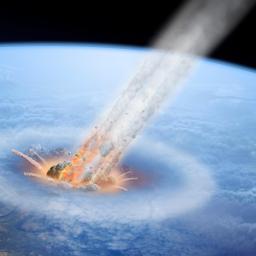
Scientists and astronauts launch appeal for infra-red telescope to detect objects that could bring catastrophe to EarthIt would be the end of the world as we know it. A relatively small lump of rock – a small asteroid, perhaps only a few hundred metres across – plunging to Earth would devastate a continent or trigger tsunamis. Civilisation would be set back several centuries.It is a real risk, say a group of astronauts and astronomers who are to highlight the threat facing humanity by marking 30 June as Asteroid Day. Supporters include Martin Rees, the astronomer royal; guitarist Brian May; biologist Richard Dawkins; Apollo 9 astronaut Rusty Schweickart; Nobel laureate Sir Harold Kroto; British astronaut Helen Sharman; and cosmonaut Alexey Leonov. Their aim is to highlight the dangers facing Earth and to help raise funds to build satellites to track deadly asteroids that may be lurking in near-Earth space. Continue reading...
|
 |
by Catherine Bennett on (#B6F7)
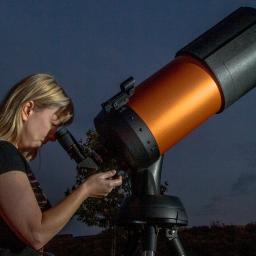
Women at the highest levels can still be made to feel not so much equally employed as lucky to be toleratedDoes there, outside convents, exist a line of work where the arrival of women does not, as a luminary of Silicon Valley has allegedly protested, “kill the buzz� Or in some other way pollute the ideal workplace vibe?
|
 |
by Observer editorial on (#B6F9)
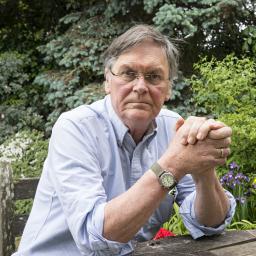
To keep up with the international science race, Britain urgently needs more women in the lab“If you’re not using half the talent in your country… you’re not going to get too close to the top.†Bill Gates’s counsel to a Saudi Arabian business gathering might be considered equally pertinent for the British scientific community, which is effectively fishing in just a little over half of the talent pool. Women make up only 9% of those working in non-medical science, technology, engineering, and mathematics (Stem) careers. Boosting the numbers of women in science and technology is critical, not just for equality’s sake but also for economic growth: Britain faces an annual shortfall of around 40,000 Stem graduates.The debate about how to increase gender diversity in science is unlikely to have been furthered, however, by the resignation of Nobel Laureate Tim Hunt following his ill-judged comments about women in science last week. His remarks were, of course, foolish and offensive, and he has admitted as much. But the brutal speed with which he was despatched by the scientific community raises questions: is this the sign of a community committed to tackling the root causes of sexism in science? Or one happy to hang an individual out to dry to compensate for its sluggishness in taking more constructive forms of action? Continue reading...
|
 |
by Robin McKie on (#B6EZ)
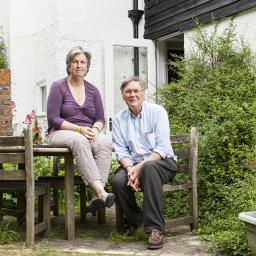
In an exclusive interview Tim Hunt and his wife Professor Mary Collins tell how their lives fell apart after his quip about women in science went viral on TwitterAs jokes go, Sir Tim Hunt’s brief standup routine about women in science last week must rank as one of the worst acts of academic self-harm in history. As he reveals to the Observer, reaction to his remarks about the alleged lachrymose tendencies of female researchers has virtually finished off the 72-year-old Nobel laureate’s career as a senior scientific adviser.What he said was wrong, he acknowledges, but the price he and his wife have had to pay for his mistakes has been extreme and unfair. “I have been hung out to dry,†says Hunt. Continue reading...
|
 |
by Robin McKie Science editor on (#B6F1)
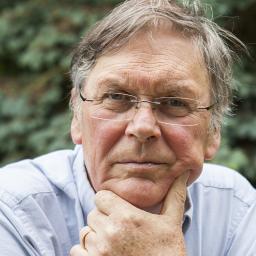
Sir Tim Hunt reveals he was forced to resign from University College London without being given the chance to explain himselfThe beleaguered British biologist Sir Tim Hunt has revealed that he was forced to resign from his post at University College London (UCL) without being given a chance to explain his controversial remarks about women in science. “I have been hung out to dry,†he told the Observer in an exclusive interview. “I have been stripped of all the things I was doing in science. I have no further influence.â€Related: Tim Hunt: ‘I’ve been hung out to dry. They haven’t even bothered to ask for my side of affairs’ Continue reading...
|